
"Held der Steine" on the trade in building blocks [Reissue]
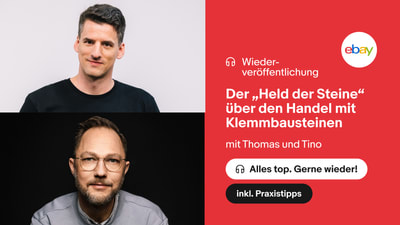
Hello dear listeners! We’re back with a re-release from November 2023: “The Hero of the Bricks on Trading in Building Blocks”. Because next week a new episode with the popular building-blocks influencer will be released. The perfect opportunity to tune in if you don’t know the episode yet!
A LEGO set of the Taj Mahal for a hefty 2,500 euros – most people would just shake their heads at that, who would spend that much money on toys? But for many collectors, these sets ‒ often still in their original packaging ‒ are real investments. The building-block industry is booming.
That this offers a lot of potential for sellers and buyers, our studio guests know especially well: Thomas Panke, aka the “Held der Steine,” is probably Germany’s best-known building-block influencer. On YouTube alone, over 800,000 subscribers follow his videos, in which he builds entire sets and examines them closely. From him we learn how he became the “Held der Steine,” what tips he has for anyone interested in browsing eBay for treasures in this category, and which manufacturers should not be missing from eBay sellers’ repertoire.
Also joining us: our former eBay colleague Tino Propp, who at the time was Category Manager for Collectibles, Toys & Model Making at eBay. He shares not only professionally but also privately a passion for building blocks and knows exactly what aspects eBay sellers and buyers should pay attention to with these sought-after bricks. Enjoy listening!
**Important Links**
- https://praxistipps.focus.de/die-7-teuersten-lego-sets-der-welt-ein-ueberblick_157304#:~:text=1.,Mahal%20aus%20dem%20Jahr%202008.
- https://www.held-der-steine.de/
- https://www.instagram.com/helddersteine/
- https://www.youtube.com/@HeldderSteine/videos
- https://www.twitch.tv/held_der_steine
- https://pages.ebay.de/ebay-lokal/
- https://www.ebay.de/verkaeuferportal/versand/abholung/
- https://www.ebay.de/verkaeuferportal/verkaufen-bei-ebay/terapeak
- https://community.ebay.de/
- https://m.facebook.com/profile.php?id=100092342473316&refid=52&__tn__=C-R
- https://www.ebay.de/verkaeuferportal/news/podcast
**Mentioned Podcast Episodes**
- https://open.spotify.com/episode/2X4OGGPcVgWNKWSZ06mEBJ
- https://open.spotify.com/episode/6PUBonFwcUo9mkiv3be0CE
- https://open.spotify.com/episode/2Q1blT4PoILia5Fu4XZLhG
** Chapter markers **
- 00:00:00 to 00:00:50: Re-release disclaimer
- 00:00:50 to 00:04:46: Intro
- 00:04:46 to 00:07:00: Where does the fascination with building blocks come from?
- 00:07:00 to 00:10:27: How did the “Held der Steine” come about?
- 00:10:27 to 00:13:56: How important is your own social media presence for your own business?
- 00:13:56 to 00:17:21: How did the cooperation between eBay and the “Held der Steine” come about?
- 00:17:21 to 00:26:37: What do buyers pay attention to when buying building blocks?
- 00:26:37 to 00:34:26: What should sellers pay attention to when selling building blocks?
- 00:34:26 to 00:38:45: Which manufacturers are relevant besides LEGO?
- 00:38:45 to 00:43:28: And now off to the fairs: Here you can meet Tino and Thomas!
David: A LEGO set of the Taj Mahal for a proud 2,500 euros. Most people would just shake their heads at that. Who spends that much money on toys? But for many collectors, especially these sets, often still in their original packaging, are real investments. And the building-block industry is booming. Our guests in the studio today also know that this offers a lot of potential for sellers and buyers: Thomas Panke, aka Der Held der Steine, is probably Germany’s best-known building-block influencer, and on YouTube alone over 800,000 subscribers follow his videos, in which he builds entire sets and examines them closely. Also joining us: Tino Propp, Category Manager for Collectibles, Toys and Model-Making at eBay. He shares not only professionally but also privately a passion for building blocks and knows exactly what aspects sellers and buyers should pay attention to with these sought-after bricks.
Thomas: So, I want to be able to see the key elements of the set. I want to be able to see the figures. The figures should have the gear in their hands. That’s 80 percent of the value of the LEGO set if the figures aren’t presented separately with gear, and also that you can see the face, that you can see whether the print is working, that everything is there, that the right body parts belong together, et cetera — those are the things that are essential for me as a buyer. If that doesn’t fit, especially with licensed themes, I’m out, just because I can’t see it properly.
David: Welcome back to another episode of “Alles Top. Gerne wieder!”, the eBay podcast about trade and e-commerce. My name is David Philippe. I’m Seller Engagement Manager at eBay Germany, and today we have a special episode because it’s all about the popular little building blocks that most of us had as children and that often still accompany us into adulthood. And who would fit this episode better than Thomas Panke, better known as Der Held der Steine? He’s an expert on everything that’s fun and can be built, and shares his knowledge with his community on platforms like YouTube, Twitch, Instagram and more. His own store in Frankfurt also makes collectors’ hearts beat faster, because there Thomas offers a changing selection of building-block models from different manufacturers, some for sale, others just for display. From him, today I want to know where his passion for building blocks comes from, how he became the “Held der Steine,” and what tips he has up his sleeve for anyone interested in browsing eBay for treasures in this category. Welcome to the studio, Thomas!
Thomas: World, greetings to you! Yes, it really was the case for me now that I would have rattled through it all in one go if I were sitting in my Frankfurt studio and we were doing this just over the computer, in some little meeting. But this way it’s of course nice to be here, to visit you on the eBay campus, which I find very, very beautiful...it’s a lot of fun, and it’s also nice to see you all in person, that’s a big difference. That’s why I eventually opened a store, a physical store, because I like seeing people, and so this is a lot of fun for me here. Definitely!
David: But don’t worry, the topic won’t just be viewed from the buyers’ perspective, but also from the sellers’ perspective at eBay, which is why I invited Tino Propp. Some people still know him as Isabel’s and my co-host, but collecting and rare items has grown so much that he unfortunately had to hang up his mic, at least for now. Tino is Senior Category Manager for Collectibles, Toys and Model-Making at eBay, and today he’ll be talking, among other things, about how the cooperation between Thomas and eBay came about, what sellers absolutely need to pay attention to when selling LEGO and other building blocks, and which manufacturers should not be missing from the lineup. But now, welcome back to the studio, Tino, we really missed you!
Tino: Yes, hello there, David, thank you so, so much! As Stephen King says: “Sometimes they come back...” and suddenly I’m sitting here in the podcast studio, and yes, I’m also happy that Thomas is here. Hi!
David: Very nice! Thomas, what interests me first of all, of course, is how your fascination with LEGO and building blocks came about.
Thomas: Yes, I think like most kids in the eighties I played a little with LEGO. Of course, I had my stuff. Back then the LEGO shelf in the toy store was somehow a meter and a half long, that was it. Which means the selection was limited. I had the stuff. A bit from the City world, of course, sure, the knights and a few “Space Police” — that wasn’t really what it was called yet, but it was the “Space Police,” and I had the stuff. Then came a good 20 years of “Dark Age,” and then, while I still had my office job, I started browsing eBay, and you kind of browse through there. And then I found a castle I had as a child back then, and I bought it. In my memory it was huge, filled the room. In front of me it stood rather cute and small. I built it, had fun, cleaned it, took photos, put it on eBay, sold it again, and thought: “This is great, I’m going to keep doing this!”
David: Did you maybe make a profit there?
Thomas: Possibly...
David: That’s insane! Tino, you’re not only on the collectibles team, you’re also a passionate building-block builder yourself and a minifigure painter and much, much more. But how exactly was it back then for you with LEGO and building blocks?
Tino: Yes, actually similar to Thomas. It was the same for me too. I was born in the seventies, grew up as a child of the eighties with all the big merchandise and franchise stuff, so from “Star Wars,” “Star Trek,” and also in the toy world, “Masters of the Universe,” “Star Wars” too, and of course “LEGO.” And that’s why... LEGO knights were always very high on our list. Then the first LEGO Technic sets were also really, really great, and then there was a break at some point in terms of LEGO collecting, and then unfortunately — or what do you mean unfortunately? Unfortunately for the wallet — in 1999, when the new “Star Wars” film came out, LEGO had also taken on the license for “Episode One.” Yes, and then I was back in again. So really, unfortunately! My wife would say unfortunately, and that has unfortunately stayed that way, I’m still a big building-block fan. There are so many other brands now that bring out great sets. Yes, and so I’m still a grown-up child.
David: You know, that’s exactly how I got to know you.
Tino: That’s how it is, and that’s a good thing too.
David: Thomas, you just said that back then you were browsing eBay and found something and then sold it again. But how did that eventually become the Held der Steine that we know now?
Thomas: So, partly because I realized my office job wasn’t what fulfilled me or what I really wanted to do. The colleagues were nice, but the job wasn’t for me, and I was looking for something, and I wanted to open a little store. That was my idea, and then I looked at what my options were. The IT field interested me, but there your stock rots away as a seller if you don’t sell it immediately, that stuff is worthless in half a year. Bookstore, also nice. But then I got into toys and stationery too, and toys is what it stayed with, because I realized that when I had built something — and maybe I also had a nice big tow truck sitting in the office at some point, some Technic truck, a cool thing — and adults came up to me and said: “Cool stuff! That’s something cool, that’s fun!” And I sold it to adults again too. These weren’t children’s play sets that I had. And that’s when I realized... there’s just good potential in it. LEGO was very, very up-and-coming back then, and that fit well. They were just changing their products, things kept moving forward, I enjoyed that. And there was no competition! Offline competition in the toy sector doesn’t exist, still doesn’t, and that’s why I thought: “Opening a store in Frankfurt, filling it with LEGO, and advising people properly, yes, that has to work!”
David: And it did!
Thomas: It worked wonderfully!
David: Yes, you already said it: unlike many of our listeners, you don’t sell LEGO and building blocks online, but so far exclusively in your store in Frankfurt. And you just said it was because the competition was small. But was it a conscious decision to say: “Nope, only in the store”?
Thomas: Yes, definitely. I can sell well, I can deal with people, and I can advise them. I can do that, and I can do it better than anyone else in Frankfurt. Online shipping...there are some who can do that very, very well, and they have the warehouse space for it, and building a warehouse in the center of Frankfurt to then ship nationwide just isn’t smart. And some others can do that better, so let them do it. Offline I can do, that’s what I do.
David: So online is completely out for you? So even a shop on eBay is out, or maybe...?
Thomas: No, we’ve discovered that there could now be a way for me to have an eBay shop and exclusively...people can buy there and pick it up only from me. I don’t want to ship, and that’s the point. I want the handoff to be to a person. That is-
David: The interaction with people.
Thomas: Exactly. Also showing again what it really is, and so on and so forth, all those topics. Quite classically with LEGO, it’s a big problem that prices are insanely high for extremely little you get. And I notice that especially with older sets when I look at them. The photos online all look the same size, and then when you actually see what you get... I want to see that, and I’ve known this process for over ten years. When someone says: “Here, you happened to have the set...?” And I say “Yes, yes, I have it. That’ll cost amount X.” “Oh, great, can I see it?” Then I show them and they say “That’s it? That’s the set? Really?” And I want to experience that moment live and then suggest something better.
David: Yes, you’ve already brought up something really important there. We recently published an episode on exactly this topic of “eBay Local,” where we explain exactly everything you need to do to enable local pickup. And you can combine that with shipping, but you don’t have to combine it with shipping. We’ll link the episode again in the show notes.
Tino: Too bad, I was just about to say that. I had just...
David: That’s what happens when you’re no longer the host.
Tino: Okay...
David: As a guest, though, you get to do other things.
Tino: I’ll jump back in right away.
David: Very good. We also recently published an episode in our podcast on the topic of social media, and talked about how sellers can use the different platforms to boost their sales, and of course we’ll link that in the show notes too. But Thomas, to what extent does your online presence help you sell products in your store?
Thomas: Actually, 100 percent. Of course, at the beginning, when the social media presence was not yet so big and not successful, it was word of mouth that helped me get people into my store. And normally, in a small store in a residential area, you expect to be ripped off as soon as you buy any set. It’s definitely a rip-off price being called up there; otherwise the store couldn’t survive at all. And then they realized that everything was actually fine, and that I have things the others don’t, and then of course you can tell your neighbor about that. But honestly, how long does it take before you reach enough people? By then you’ve already starved to death! So — the alternative was to advertise in the newspaper, and then I ran an ad for four and a half and tomorrow fish gets wrapped in it: not smart either. And then there’s the internet. The thing is free when you advertise for yourself via social media. You just have to invest your time, nothing else. And at the beginning, when I was sitting alone in a store that wasn’t really running yet, you have time. That’s what you have, and you can use it, then you can film yourself doing things, you can present the products. I did both. You can start looking around and of course networking, and that’s how you grow your store. And that’s a sensible thing, and we can’t afford to buy “Google Adverts” against “Kaufhof LEGO.” Even if they can’t sell and have terrible prices and a lousy selection and no advice, they have money, and at that moment they buy me to death. But if you do that yourself, and you build it up, for example by opening an eBay shop so you have a storefront. People can see everything you have, you promote it via Instagram, you post stories, maybe, I don’t know, make videos on YouTube. If you like that, then it’s definitely a major win, and if you’re a seller, you should actually also enjoy presenting yourself. I think that goes together. And as a seller you need to be a bit of a show-off, and when someone puts a camera in front of me, I start talking, and then it works.
David: Microphone works too
Thomas: Microphone works too.
David: What’s very nice is: originally I wanted to ask you whether you had any tips on using social media for our listeners. But you’ve already said so much. So I can basically save that question.
Thomas: Sorry.
David: No, I think that’s great, because it simply shows that when you’re passionate about it, when you’re a convincing seller and you’re also on fire for your topic, then I think at some point it’s just a...yes, you should just do it, and I think anyone who’s still wondering today “Should I do this? Should I use social media?” the answer is “Yes, definitely!”
Thomas: Definitely! And above all, just look around: the big companies still don’t have social media channels. They have social media channels where they run their TV ads, and their, I don’t know, newspaper ads are posted there as an image. That’s not social media. And that’s exactly the point: as a small — especially small — independent seller, you can put yourself as a person in the foreground, and that’s what social media is about. And a faceless company with constantly changing management can’t do that. It doesn’t have a face! They can buy influencers — and they do, in large numbers. But it’s actually authentic and credible when the person standing in the store, the one you also see when you come into the store, the one standing behind the counter, also has their face visible in pictures and videos. And then it works. And that’s why the small store always wins against the big chain in advertising, every single time.
David: I can already tell: for the next social media episode, we’ll invite you too!
Thomas: And Stef, definitely very important! And then there’s expertise here, it’ll be incredible!
David: But before we get to tips and tricks around buying and selling LEGO and building blocks on eBay, I’d like to talk once more with you about the cooperation between eBay and the “Held der Steine.” Tino, first with you. What exactly is that about? What are we doing with Thomas?
Tino: Ah, so, we have a cooperation with Thomas. Of course it’s all about building blocks, but it can also be about other collectibles, because Thomas is also an enthusiastic collectibles collector. So statues, I think it was, DC.
Thomas: Statues, yes, yes.
Tino: Exactly. And here he actually gives tips for the treasure hunt on eBay. So what should you really pay attention to? He does that through reels, stories, social media, so Instagram. He’s also linked us, for example in his YouTube videos. He provides advice there: how do you buy LEGO building blocks, for example? What should I pay attention to, which keywords and so on? “Lot” is, for example, an exciting topic.
Thomas: Very exciting!
David: And how did that come about? So who approached whom and said, “Let’s do something!”?
Tino: Yes, so I’ve already... or I’ve been following — I almost said “fanboy,” as you always so nicely say, Thomas — following Thomas for a very long time. Your YouTube videos are simply fantastic in the review and also in explaining the details of all the building-block sets. And then we just wrote to him, and then we also got an immediate reply from Steffi, your partner, or your sidekick, as her signature so nicely says — and then it started. So, I’ve rarely had such an uncomplicated onboarding and first contact as with Thomas and Steffi.
David: Thomas, we’ve already noticed that you’re quite the expert when it comes to social media too, and then of course the question always comes up when you enter into collaborations: how does that go over with the followers? And here the question is, how does the collaboration with us, with eBay, go over with your followers?
Thomas: Positive feedback. It goes over well because it naturally fits my overall concept. I’ve effectively been passively advertising eBay for years already, because I always say, “Don’t buy the expensive stuff just somehow off the list there. Wait until used gets better.” There’s hardly any reason, especially with LEGO, to buy new at a very high price. Of course, there are high-end collectors who say, “Okay, the thing has to be in perfect packaging, perfect seal, no scratch on it, never seen sunlight and so on, it has to be put in the corner.” Of course they exist, they have their justification, they enjoy it, they find fulfillment in it, but many people just want to build the set. So, very, very simply. And why should you pay completely inflated collector prices if you’re just a consumer and not a collector at all, and eBay is the best platform for that. And if you know your way around a bit and go through the photos a little, and you see two or three parts that you know could only have been in two or three sets, then you can estimate the value of that lot quite well. You need to know a little, you need to pay attention to the details, and then you can go through it, and then you have a lot, a lot of fun. It fit incredibly well, and that’s why, I think, if the things — because I have to — weren’t marked as advertising, many people probably wouldn’t have noticed. They would have said, “Yes, that’s the format he does with us here on the channel,” and it would have fit. So that’s why this is a cooperation that runs very organically and naturally.
David: But before we get into what to look out for when buying and selling LEGO and building blocks, here’s a quick note for our listeners. We’re always very happy when you send us feedback on our podcast episodes, and of course you can do that either in the eBay Community or on our Facebook page “eBay for Business Deutschland.” So feel free to write to us whether you liked this episode and what topics you’d like to hear about here in the future. And with that said, we’re now starting the most important part of this podcast episode, at least for our sellers, namely trading in LEGO and building blocks. We’ll be comparing two perspectives here. First, buying. Thomas is our absolute expert here, and selling. That’s what we have Tino here for. I’d like to start with buying. What you can’t forget is that it’s essential for the success of a business to put yourself in the buyers’ expectations. And that’s why sellers should also listen carefully now. Thomas, why is eBay the ideal marketplace for you to buy LEGO and building blocks?
Thomas: For several reasons. One thing is that there’s an incredibly large selection. That’s always a good thing, because you need to know the market, and the market is reflected on eBay. That means you actually get a pretty good market analysis from a single source. You can — which I think is a very, very nice feature — look at the sold items from the last...was it even 60 days? I don’t know, it was long. In any case, you can look at the sold items for at least 30 days, and that’s always my first click. So as soon as I’m looking for something, I check what’s been happening on eBay over the last few weeks.
David: You do that to get a sense of the price.
Thomas: As a buyer, yes, you first have to know what price phase you’re in right now. And that’s especially true around Christmas or whenever there’s a holiday and suddenly the prices go crazy, and you don’t really know why. If you go a little into the past, you can already see where you stand. That’s always my very first step. The other is, of course, that I see many brands at the same time. It’s not like in a department store, where they usually have a good contract and the goods are there, but you see different sellers. Especially with building blocks now, you have LEGO shops that exist, but also very strongly “Mould King” is represented with its own shop, for example. We have lots of offers from “Cobi,” so from very, very many. I’d almost say from all brands you can see sets. That means you get a good market overview. In addition, of course, you don’t just have new goods going through sellers, but also used items, which is also great because you can get an idea of what the goods might be worth. Is it a pure collector’s item, or is it actually played with? Then there are also individual parts you can buy, or individual figures, which is especially important with pure branded products like LEGO, because many people collect the figures. And then you can, and this is always my absolute buying tip: if you like building...that’s a difference, do I like collecting minifigures and need to buy LEGO, or do I like building building blocks? If I just like building building blocks, you can definitely buy LEGO. But I would buy on eBay the sets from which the figures have already been taken out by the sellers; they sell those separately for profit and then want to get rid of the bricks. You can actually always get a very good deal there. So there are different ways to approach it. You can look at the market, then categorize which buyer group you yourself belong to. You should be a little honest about that, and then you can go hunting. And then, of course, my greatest fun, as I said, watching an auction and maybe not clicking yourself into a buying frenzy. So maybe from eBay’s perspective you should, but for yourself you should think about where you’re heading, and then you should have fun.
David: There’s that nice option with the maximum bid, where you enter it once and maybe never touch it again.
Thomas: But that’s the dangerous point!
David: I know, I know it myself!
Thomas: You can fix that later.
David: But now, just a little more off the record: what are, let’s say, your two most important tips on what to pay attention to when you want to buy LEGO or building blocks? What should I look out for, apart from “How has the price developed?”
Thomas: So, the first would be, if I... of course you choose a reputable seller. That applies... on the seller side too, you can wonderfully look at the reviews, what the seller’s history is, the story it tells. Likewise, of course, with private sellers, for me the point is always what does it look like where the photo was taken, where the building-block set stands? That’s a point where you can already think along, and after that, with the seller, it’s good — these are brand-new goods in original packaging, I mean, there’s not much to worry about there — as I said, you should have made that product selection. But if you buy used, definitely, if you’re a bargain hunter, go for lots. It’s always cheaper if you buy several sets that are bundled, because three or four sets in there are uninteresting to many people, and so the price... they don’t bid on it. But you yourself get a big haul. And of course you hope maybe the seller isn’t so experienced at that moment, and then maybe you have a good chance. Bad times to list, for example, I like going on eBay at off-peak times and looking. And I mean lying on the couch on Sunday mornings and browsing eBay, I think many people do. It’s a bad time to jump into an auction, but I have my livestreams in the evening, into the night. Lots of things happen then.
David: I get it, I get it. We’ve already used the word “lot” several times. For those who maybe can’t make sense of that, could you briefly explain what a lot is?
Thomas: Ah, so, I... maybe that’s not the dictionary definition I’m using there, but for me a lot is a not really systematic collection of different sets. Often used, often incomplete too. In other words, the kid played LEGO for six years and at first liked “City,” then three “NINJAGO” sets came along, then a short “Star Wars” phase, a little bit of Technic, and then something else was interesting. So, and then throwing those twelve sets into a box is a lot for me.
David: And in the sense of, the kid has also moved out for six years now, and it’s still sitting around, and now it has to go.
Thomas: Exactly, and that’s the thing for me. Many see that as large, valuable collections. A collection, for me, is when it really has a system, when you say, I have 20 Star Wars sets here, connected, whatever, “Clone Wars,” from a certain era. And then I say, that’s a collection. Everything else is a lot to me, and buying something like that is the most worthwhile, and eBay is made for that, definitely. Bought the stuff, into the laundry bag and into the washing machine, had fun, and endless sorting and building!
Tino: Actually, I can add to that, not just sets but also individual bricks are often offered as lots or by the kilo, because many building-block fans build entire cities at home. So, that’s really crazy, you can look at it on YouTube, Insta, everywhere.
David: I used to do that too.
Tino: Yes, actually, and that’s the perfect marketplace for it.
David: We’ve already heard a few keywords. Thomas, can you maybe say again, if you’re now looking for such sets, lot was one keyword. What are some keywords you would otherwise search for to find your treasures?
Thomas: So definitely broader terms. I usually like that when someone maybe doesn’t yet know 100 percent what they’re entering. Of course you can enter brand names like “Star Wars” and so on. But then everything comes up. But of course I like going for things like “knight” or “warrior” or “spaceships.” That’s great if someone enters “spaceships” instead of “LEGO Star Wars.” That’s awesome. And then classic number transpositions are a point for me. Very, very expensive sets can be entered with a number swap. I’m definitely always on board there. And as I said, classically, when I go to auctions, I search for “used LEGO.” Use the filters. I go through the wonderful filter functions and then like to add a keyword, simply saying “lot” or “collection.” And then things come up. And then you have to put yourself a bit in the seller’s shoes and think what they were probably thinking at that moment, or what they weren’t thinking.
David: Number transpositions, you mean... every LEGO set has a very clear identification number...
Thomas: Correct.
David: And that’s often included in the titles too, and if you have a transposition in there, then that’s not good. At least for the seller.
Thomas: Correct. It’s not good, because their set may lose 90 percent of its value, or at least attention at first. And then of course it’s nice if there are a few of us. Well, it’s enough if someone else knows their way around too. But it’s just, I like looking at the things, I have fun seeing what happens with something like that until it eventually gets pushed up, at some point. But maybe they also have a “buy it now” in there. You never know!
David: Thomas, you’ve already said a lot about what you pay attention to in order to pounce, so to speak. Are there things where you think, “Oh, that’s a definite warning sign, I should stay away from that”?
Thomas: Well, first of all, of course, when it comes to sets, there are things. I know, there are simply sets that are bought as eye-catchers, and those are just weak sets, and then I can see when someone is preparing it, but of course that’s always very specifically tailored to what you’re interested in... that these sets are positioned so you don’t really have a perfect overview. So, I want to be able to see the key elements of the set. I want to be able to see the figures. The figures should have the gear in their hands. That’s 80 percent of the value of the LEGO set if the figures aren’t presented separately with gear. And also that you can see the face, that you can see whether the print works, that everything is on there, that the right body parts belong together, et cetera. Those are the things that are essential for me as a buyer. If that doesn’t fit, especially with licensed themes, I’m out. So if I can’t see it properly. The second thing is, of course, that especially somewhat older LEGO sets... there was a big wave in 2002, and in 2008 many molds were changed at LEGO. The older parts have become very expensive, the newer ones are cheap. That doesn’t mean the newer ones are worse, but for collectors it’s of course important that the old ones are there. These elements need to be worked out if someone wants collector value for an old LEGO house that cost 100 euros and now is at 2,000, and they don’t make the effort to clearly work out why that thing costs 2,000, I wouldn’t buy it.
David: Tino, then let’s turn things around. We’ve heard a lot about what to pay attention to when buying. But why is eBay not only the ideal marketplace for buying, but especially for selling LEGO and building blocks?
Tino: We can actually jump straight back to Thomas’s answer. So everything he said about buying can be mirrored exactly for selling. So those are once again really great tips Thomas gave here. We’re a marketplace with a huge selection of products, so of course not just building blocks, but today it’s of course about building blocks, and those are of course partly collectibles too. So we offer the goods, on our marketplace we have new goods, but also especially the old sought-after goods, the so-called “end-of-life sets.” So, “EOL,” in case we hear that later again. And I see a very, very big demand, a very big request, also on our marketplace, especially for these old sets, and we have all that. So you can basically search for almost any LEGO set simply with that item number, also in the title for example, and you’ll find it on our marketplace. And that makes us quite unique, I think.
David: And I mean, we can also see from Thomas’s success that people are indeed interested in exactly that, these used LEGOs and the old sets, and the... well, also the collectors who are active there, and of course they want to buy too. So, there is obviously a demand, right?
Tino: Yes, of course, and actually sometimes also as an investment. That’s something I saw just last year. Somehow the cost of living has risen, but LEGO sales, for example on our marketplace, were almost similar to gold. In times of crisis, expensive sets suddenly get bought, although nowadays you do have to be a little careful about what will actually increase in value. So if you buy an expensive LEGO set, for example, and we’re talking about items that can cost up to 899 euros, you have to be very careful with the speculation that they’ll someday be worth 999. I’d be a little more cautious there.
David: Tino, you mentioned the topic of investment, LEGO as an investment. Thomas, are there any, let’s say, indicators of what is likely to be traded as value-increasing and where you might not get anything out of it but instead end up paying more?
Thomas: Yes, so, there are a few indicators; they’re not 100 percent certain, but they can give you good orientation. The first is the “part-out value.” That’s the sum of the value of the individual bricks in the set. If that is clearly above the recommended retail price, there’s a high probability that once the set is no longer produced by LEGO, which normally happens within one to three years, then as soon as someone wants to have it and tries to build it from individual parts, they realize it will be more expensive. Then I take the offer from the internet as new goods, and on that value it will definitely go up. That’s the classic example. The next topic is of course collector value. If you say, “Okay, this is something, there are special figures in it,” then we’re back to the topic of “Lord of the Rings,” “Star Wars,” and so on. That’s actually an indicator when you say, this is something classic above all. Side themes from Star Wars are sometimes a stroke of luck. Sometimes it works, sometimes it doesn’t. Some “Old Republic sets” are still molding away on some shelves, or “Rogue sets.” But with some of them they realized, “Darth Malgus” is definitely good. And now such a weird little “Darth Malgus” figure from a set I had in the store in 2013 is worth more than the entire set was back then. The set is still worthless if that figure isn’t included. So those are the kinds of things. That’s speculation, you can’t count on it. But a classic... a classic “Millennium Falcon” will never lose value. It will always be bought. That’s not a problem. Part-out value is an important point. LEGO has massively increased its prices, which means it’s becoming less and less worthwhile. But there are definite outliers, and always a good guarantee is a set that was sold exclusively only by LEGO itself. You can still buy it on eBay, but actually the retail route is exclusively through LEGO. Those are then small quantities and often very short production runs. If you get such a set, which on top of that has a license, on top of that a good part-out value. That’s a sure winner.
David: Definitely super exciting and a science in itself. I’ve also learned a new word again: “part-out value,” so the value of the individual bricks compared to the set. I can tell I’m still very, very little involved in this topic. But now we want to talk a bit more about selling LEGO. What should sellers pay attention to when listing their offers? So what should they consider so that they’re especially attractive to buyers? And what options do we offer as eBay for that?
Tino: So generally, listing items on eBay is relatively easy. So from the listing flow, whether you’re a commercial seller or just a private person wanting to sell something. Important when selling, definitely first of all things like the title. Thomas already mentioned that. Do I include the LEGO number there, or keywords like “Star Wars,” “lot,” or “by the kilo,” which is also a very frequently searched keyword for building blocks. Then of course the pictures: crucial. I would also always recommend actually using isolated images, meaning pictures with a white background. You can use eBay’s image tools for that, for example. Super easy, and you can also improve your pictures there. Item specifics, very important...
David: Always a popular topic with us.
Tino: Really! We’ve already been able to hear one or two episodes about that here. Actually mega important. If it’s a set with an EAN number, for example, include that too, take the time. You’ll simply be found much, much better in search. Description, I already said, and if I’m selling something privately, for example... I always run ads for my listings to increase visibility. You have a huge number of listings, for example with “Star Wars,” “Lord of the Rings LEGO” or whatever, and if you then run an ad on top of that... it’s only charged when you sell, for example, with us... then the chances of selling simply increase even more. And especially to come back to the C2C topic, so private sales, auctions work wonderfully! So that’s actually... I usually start with 1-euro auctions, and if you have really exciting items — which is why searching beforehand to see how they might develop on eBay is also important — in the last few minutes that usually shoots up enormously.
David: But that sounds the same... it’s not just for private sellers, but also for commercial sellers. And they can additionally use the “Terapeak” tool. One more tip there too: with “Terapeak” you can search by keywords, see how similar listings have developed, price trends, and, and, and... so we also have a separate episode on that. So once again on the topic of ads, you put that very nicely. Ad standards that you can use. We also released an episode on that recently. We’d be happy to link it. But also the whole topic of listing optimization, we had a nice episode where we explained exactly what to pay attention to. Of course that also applies to LEGO listings.
Tino: Yes, and to add to that, in the “Seller Cockpit” you can also wonderfully design your own shop in your account, for example, whether by top offers or top categories, you now have wonderful options to bring your inventory to customers in an interesting way, and customers too.
David: Yes, very important, we just learned: make sure you don’t have a number transposition in there, otherwise it’ll be unpleasant for you, and then clever people like Thomas will be happy that they might get a bargain. And of course you don’t want to do that as a seller. We’ve talked a lot about LEGO and building blocks now. There are now many providers of colorful bricks that no longer go by LEGO alone. Thomas, which manufacturers could you recommend to our listeners that are just as good as LEGO and maybe also have some very interesting sets and simply bring a similar fun factor?
Thomas: Yes, there’s definitely a big colorful bouquet by now. Dozens of manufacturers. Actually, if you want to stay European, and it is in fact the only manufacturer of, let’s say, relevant size that I know of that produces exclusively in Europe, it’s “Cobi.” It’s a Polish brand, very, very high-quality sets. Great prints, practically no stickers. But they are not play models, they are actually display pieces. They have a strong military area, which is of course exciting for many people because LEGO only covers that area fictionally. In addition, they also have very, very nice models of what to me are youngtimers, though in the world they’re probably oldtimers by now among young people. I think they’re youngtimers. They have those. Then they have very nice ships, they have airplanes, so things like that, they really have very, very nice models. Very, very high quality, great instructions, no problem. They also distribute in Germany, so absolutely reputable, no issues getting them. Then we have the next things. Then we have a large colorful bouquet of Asian manufacturers who are either assemblers, like for example the German “BlueBrixx,” which takes Asian bricks and assembles them itself. And I would say the quality market leader right now is “GoBricks,” but that’s a brick supplier. “Mould King” uses many bricks from “GoBricks.” Very good, but they’re very little printed. “Panlos” is very good. They have great prints, they have great own bricks that they use, huge models. But the most important thing is that you first know from the outset which direction you want to go. “BlueBrixx” has just brought brand-new figures to the market. There’s also one from a German seller, Steingemachtes. And now there’s “Kiddicraft,” the original inventor of the building blocks, who has now come back to the market.
David: Exciting.
Thomas: They also have their own figures. And figures are of course essential especially for children, for role-playing. If you don’t have them, it’s difficult. The other models are for old people. That I enjoy building a big castle with 10,000 pieces is clear. If you can’t then play with figures afterward, it’s worthless for a child. And that’s also right, and you simply have to know your market, and there are definitely sets or manufacturers that are only moderately good for children. So as I said, “Cobi” for children... sure, there are always children you can inspire with it, but 95 percent are adult collectors who put the thing in the display case, and for that “Cobi” is a dream. And then there’s the other thing. If you just want a lot of bricks, you can also buy quantities of bricks from these alternative manufacturers on eBay, because they have, and I think that’s a dream, no high collector value. Because it’s about the fun of building. Afterward you’ve built it and then you sell it again. There’s no brand, no long-term image potential in it that makes you store the stuff in the basement. You build, you have fun, you sell. And if you just want to get a lot of bricks on a low budget, then these are the manufacturers. Pay attention to, as I said, “Mould King” very, very stable, “Happy Build” very good, “Cada” for Technic. As soon as you want LEGO Technic with plug connections, “Cada” in my opinion is also much better than LEGO Technic itself. They’ve overtaken them, and by now basically out of reach. They also have their own licenses, they have great parts. So yes, there’s really a colorful, colorful bouquet. All to be found on eBay. You can have a lot of fun with it.
David: Tino, can you actually add anything else or has Thomas already said everything?
Tino: I’m just thinking. I think you’ve already covered everything, but “Playtive” just came to mind. They also make very, very nice sets, including ones from “Asterix.” “Lucky Luke” is now somehow... coming out or...
Thomas: Correct, coming out.
Tino: Coming out now, exactly.
Thomas: Those are “Panlos bricks,” by the way, just to mention again, that “Playtive” uses.
Tino: Ah, exciting, I didn’t know that, for example. Also those “City sets” are great. Police station, fire department, and so on. That’s what would come to mind for me now.
Thomas: Correct.
Tino: Exactly, and actually all these lovely things can also be found on our marketplace, so on eBay.
David: That’s nice too; so for everyone who wants to buy or sell, we now have a good overview of potential brands to take a look at. Tino, I can tell, I could talk with you for hours about this topic. If our listeners are thinking, oh, I’d like to do that too sometime. Is there then a way to meet you somewhere, let’s say at an event or a trade fair, and I mean as a preview, what’s planned for next year?
Tino: First of all, we don’t even need to look that far ahead, because the next trade fair or convention is already just around the corner again. On 9/10 December, my colleague Tobias — who has also been here a few times in the podcast, by the way, when we talked about gold and trading cards, greetings Tobias — exactly, and I’ll be at the “Stuttgart Comic Con” with him on the 9th and 10th of December. We’re really looking forward to it again, and we’ll have our own booth too, so you can actually find us there and ask us anything, and we’ll also have a prize wheel again, so you can win something too.
David: Very good, but do you already have plans for next year or is it just “first Comic Con and then see what comes”?
Tino: Spring is actually a bit quieter when it comes to trade fairs. There will also be a building-block fair in April/May. I’m considering whether to go to that too. Otherwise, of course, the big games fair in Nuremberg. But I go there for the industry. That’s where you find all the great new products, not just from building-block manufacturers, but also action figures, all the trimmings, or board games. And then things pick up again in autumn with “SPIEL” in Essen and so on and so forth. So we... and a few conventions in between too.
David: I notice it every time I talk to Tino: your job is simply your passion, and I’m a little jealous that you get to go to all these great events. Thomas, how is it with you? If our listeners say, “Oh, I’d love to meet Thomas sometime,” but they’re not exactly coming to Frankfurt to your little store. Is there a way to get more tips from you there, apart from your livestreams or videos?
Thomas: I was going to say, my livestreams are very suitable for that. I have a lively live chat there, which works very well. On top of that I have an incredibly good community, meaning we have a few thousand live viewers, and the chat is active. That means I don’t see every question and can’t respond to every one, but the chat helps each other very, very well. On top of that, of course, we’re active on Discord too, and we have a community there as well, which runs very well. My store is of course open; my dear Stefan is there every week and takes care of all building-block matters. And as soon as the temperature allows it, because it’s a bit of a street sale, I’m standing there basically out on the street, then I’m there once a month too, over the weekend for three days, and people can chat with me, and then of course at conventions. We were just in Frankfurt, at the...
Tino: Exactly, at the “Trading Card Convention,” exactly.
Thomas: Exactly, we were there together too, and I chatted with many of the people who were there. And we’ll definitely see each other at Comic Con. We’ll also see each other in Nuremberg. Those are all the places where I of course also show up, possibly to see a nice statue, but also possibly to see what’s happening in the toy market. Generally because I’m interested in trends, because normally LEGO is the market leader in the toy sector, but still they don’t set all the trends, and then I’m always curious what the others are doing to see which direction the whole industry is moving. And LEGO leaves out anything to do with light, for example, and motors and stuff like that. They’re light years behind the industry there, and of course I’m interested in what the others are doing. I have to make sure my customers don’t drift away and go somewhere else. They stay nice and cozy with me and keep building with building blocks.
David: Your “cuddle community,” as you so nicely call it, right?
Thomas: My “cuddle community.” Something else just came to mind, since you were just talking about the strong brands. Of course we also still have a completely dying player in the market with “Mattel.” They also have building blocks, hardly anyone knows that because they have no distribution. But there is still “Mattel,” by the way, just wanted to mention that briefly. They have great brands.
Tino: Awesome! So not just “awesome,” but...
Thomas: It is awesome, and they also have the things people want. Halo, for example, comes to mind just now, and of course “Witcher,” and “Game of Thrones”...
Tino: “Masters of the Universe.”
Thomas: “Masters of the Universe,” very important. They released a “Tesla model.” That’s also often a price-performance winner because the bricks are being beaten down in the market. So maybe that’s also a secret tip if you want crazy colors, and yes!
Tino: That’s something exciting! And the “Pokémon sets” actually look very cute.
Thomas: And the cute “Pokémon sets,” exactly. That’s how it is.
Tino: But actually rather under the radar for most people.
Thomas: Yes, completely.
David: Yes, all that remains for me to say is thank you so, so much to both of you for coming into the studio today! And it was just totally exciting for me again to get to know you, Thomas, and of course, Tino, seeing you again was also simply a pleasure. But also to learn more about your story. Above all, it was incredibly interesting what you were able to bring us here about the, let’s say, wants and needs of LEGO and building-block buyers. And of course, Tino, thank you for shedding light on the whole thing once more from the sellers’ perspective and what we do at eBay. I think it has become clear again how important it is to understand your customers if you really want to sell successfully, and that as a seller you’re also allowed to be a little passionate about your products.
Thomas: You definitely should. I had a lot of fun, thank you very much for the invitation! It was a party, very nice!
Tino: Yes, I can only add to that, I had an incredibly good time too. We’re lowering the mics now, and then we’ll do a bit of nerd talk, I’m already looking forward to it!
David: Yes, but before we start the nerd talk now, I’ll say goodbye once more. But one small note for our listeners: as explained earlier, we always appreciate your feedback, but of course also if you help our podcast grow. And you can simply do that by leaving a subscription or a like where you’re listening to us right now. And with that, thank you again for listening and until next time. Bye!
Tino: Bye!
Thomas: Bye!

n.ikla70
@850i1 You complain about people who supposedly don't stick to spelling, but you don't do it yourself. 😞
850i1
Holy crap, stop with this gender **bleep** already!! Who do you think you are to just override German spelling rules.