
How to Social Media: Tipps von Baby got Business & missforty
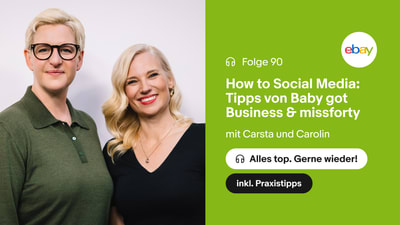
You sell great products, but presenting them optimally on social media is still a real hurdle? You're not alone! Social media offers huge opportunities for more visibility, customer loyalty, and sales — but how do you use it properly?
Carsta Maria Müller, podcast host of “What the Social” and Managing Director at Baby got Business, and eBay seller Carolin Handschuh, who successfully sells fashion for women 40+ with @missforty_40 and talks about her life as a seller on her social media channels, know this.
Together they share valuable tips on how to increase your social media presence, gain more visibility, and strengthen customer loyalty — all without expensive advertising! In addition, they explain why authenticity is the key to success, how to develop a content strategy that fits you and your business, and why spontaneously posted content often performs better than carefully produced content.
You also have the chance to win a social media quick check worth over €1,000! Perfect for beginners, advanced users, and pros.
Ready to make your business visible on social media? Then listen in now!
**Important Links**
- Baby got Business
- Carsta Maria Müller on LinkedIn
- Carolin Handschuh on LinkedIn
- missforty on eBay
- More information about the eBay Awards 2025
- eBay for Business on Facebook
- eBay for Business on Instagram
- More info about the eBay podcast “Alles top. Gerne wieder!” and our podcast hosts
** Chapter markers **
- 00:00:00 to 00:04:03: Intro
- 00:04:03 to 00:10:54: Why is social media worthwhile for sellers too?
- 00:10:54 to 00:16:37: Why you should be authentic on social media
- 00:16:37 to 00:18:07: Spontaneous or planned: What works better on social media?
- 00:18:07 to 00:25:25: The keys to success: content strategy, planning, and consistency
- 00:25:25 to 00:25:57: Baby got Business giveaway
- 00:25:57 to 00:28:45: Which platform is right for my business?
- 00:28:45 to 00:31:59: Why you shouldn’t overdo clickbait
- 00:31:59 to 00:32:23: eBay Awards 2025
- 00:32:23 to 00:39:14: Carsta’s and Carolin’s favorite tips
- 00:39:14 to 00:40:32: Outro
Carsta: We spend a lot of time on our phones. We spend a lot of time on social media channels. Even if we’re not actively posting, we’re consuming. And depending on your age, you might be on Facebook, maybe Instagram, maybe TikTok, maybe LinkedIn too, and the time we spend there is of course potential time where I can reach people who would want to buy something from me.
Lisa: Welcome to "Alles top. Gerne wieder!" - the eBay podcast all about commerce and e-commerce. I’m Lisa Haak, and today we’re giving you practical tips on how you can build and expand your social media presence with simple steps. As always, I’m not alone in the studio; I’m welcoming two fantastic guests. First, Carolin Handschuh: she’s a seller and entrepreneur with a very strong presence on social media. With her missforty_germany account, she runs a successful fashion shop for women over 40. On sell_like_miss_fourty, she gives exciting insights into her day-to-day work and her journey as an e-commerce seller into the digital world. Whether she does that on Instagram, LinkedIn, or other channels, her trademark is definitely authenticity and an entrepreneurial spirit. Carolin, welcome! Great to have you here.
Carolin: Thank you very much!
Lisa: And we’re also looking forward to Casta Maria Müller. She’s a social media professional, podcast host of "What The Social!?" and Managing Director at "Baby got Business". She advises companies and sellers on personal branding, social media, and digital visibility. Great to have you here, Carsta!
Carsta: Thank you for the invitation.
Lisa: Now you’re both here, and we already had a little pre-chat. Our listeners don’t know you at all yet. We want to change that a bit. We prepared you and asked whether you could bring a little fun fact about yourselves. Carolin, let’s start with you! What’s a fun fact about you that our listeners definitely need to know?
Carolin: I thought long and hard about the fun fact, and anyone who knows me from social media or privately knows that I’m definitely a funny, spontaneous person. But I brought something a little more serious. I actually trained as a pastoral counselor in the Catholic Church. And that’s something people really don’t expect from me.
Lisa: Wow. No, I didn’t know that either. Even though I’d say I follow you, and I know more than you probably think I do.
Carolin: I always wondered whether I should play that in the social media game, but I think I’m keeping something like volunteering and pastoral counseling out for now. So it’s not exactly a fun fact. But it is part of who I am, and a lot of people probably don’t know it at all.
Lisa: Great, thank you very much. Carsta, how about you? What’s your fun fact?
Carsta: I actually brought a fun fact. We already talked about it beforehand: I have 90-something pairs of glasses — actually 91 now, because last week another new pair was added, and I’m wearing that one today too. And yes, that’s really a little passion of mine, because my parents are opticians and I’m right at the source, and every time I visit them, I honestly leave with another pair of glasses.
Lisa: Inherited passion?
Carsta: Absolutely! The only thing I have to do with optics is wearing the glasses.
Lisa: Very nice glasses.
Carsta: Thank you.
Lisa: Worth the investment. I’m curious about the other 90. Very good, today we want to talk about social media. You both deal with it every day. Maybe let’s start a bit there, Carolin, you’re a seller, which means your job isn’t actually social media as your main profession. Maybe now it is? We’ll maybe clear that up a bit today. But why is social media worthwhile for sellers too? And how did you come up with the idea?
Carolin: Well, I always find it a bit hard to give a blanket answer to why something is worthwhile and just say, yes, it definitely is. Because I’ve been doing Miss Forty for six years now. And in the beginning, for example, I didn’t really live social media at all. And I had quite a big inhibition about even putting myself out there. And what’s really interesting is that I always felt uncomfortable when friends saw me, and I’d think, oh no, how embarrassing — and then just realize you grow into it. But I started without saying, okay, I have a very clear selling goal and I’m actively selling right away. For me it was initially more about visibility, and also about daring to be a little more visible. I show a bit of who I am, what I do, and then of course also what isn’t going so well, because you probably know this from Instagram: you spend the whole day seeing, wow, people look great, they’re doing great things, and then in the evening you feel like, why wasn’t my day actually that great? And I noticed that taking people along with me and saying no, today wasn’t good and things aren’t going so well right now — yes, that develops from there too. So I would definitely say it’s worthwhile. But I also want to say it’s not something that... if someone doesn’t want to do it, I’d say... do what feels right for you.
Lisa: Probably also a bit out of your own passion. You sell fashion for women over 40, and the pictures people see in your online shop are partly you, right? So you’re also your own model for your own brand, you stand for yourself, and that’s how you got into social media too.
Carolin: Exactly, but that was also a story like this: I once made a beanie with Miss Forty Germany on it. And suddenly people wrote to me on Instagram asking where they could buy that beanie. And I thought, hmm, actually you can’t buy it yet — I made it just for fun. And from that, the idea was born a little. And of course at the beginning you also have to say that there wasn’t budget for any models, so I said, okay, then I’ll do it myself, I trust myself to do it right now. I had rather basic equipment with the iPhone in the living room and retouched the background out and thought, okay, let’s just do it! And that’s how the whole idea came about.
Lisa: Carsta, you advise sellers and entrepreneurs too. Why is it worthwhile to have a social media strategy or even just to start with social media at all? And like Carolin says: I have an iPhone, I can just get started.
Carsta: That’s relatively easy to explain. We spend a lot of time on our phones. We spend a lot of time on social media channels. Even if we’re not actively posting, we’re consuming. And depending on your age, you might be on Facebook, maybe Instagram, maybe TikTok, maybe LinkedIn. And the time we spend there is of course potential time where I can reach people who would want to buy something from me. And the media shift has happened. People watch less television; they’ve moved more toward streaming. We all somehow have our phones or iPads in our hands when we’re consuming TV or something else, and accordingly, as a seller, I want to be where people spend their time, where people spend their leisure time, where people are bored. And most people actually go on social media because they’re bored, because they’re standing at a bus stop, because they’re in a meeting that’s boring, or for whatever reason. And accordingly, sneaking in there and being there, ideally organically too, meaning without me having to pay for it, is of course a win-win situation. Although, of course, that’s also a bit twisted, because you pay with the time you put into maintaining an account. Social media doesn’t happen overnight because I made one post. Social media means strategy. Social media means sticking with it, always continuing, even when the numbers aren’t that great. Even when friends may laugh about it. So social media is free in itself, but the price you pay is not exactly low.
Lisa: That was almost already a conclusion for the episode, without us even getting into it. But there was so much in there, and I definitely felt second-screen guilty. That’s something I do too — it can be my favorite series, and I still have my phone in my hand. Carolin, we spoke a few months ago, and a question came up for you: I do a lot with Miss Forty Germany and basically talk about myself there and my journey as a seller. And it was a bit about Instagram. And on LinkedIn you’d already done a lot, and then you decided to separate the accounts — and I’d say one account more relevant to your fashion brand and one about Carolin Handschuh and how the seller from Miss Forty sells. What was the thinking behind having these accounts separately?
Carolin: The main reason was of course that with Miss Forty Germany I also have more private customers who then follow the brand itself, but I realized that the fashion gets bought, but the interest in me personally or in my life, I see that massively on LinkedIn, for example. That’s grown over the last few years or the last two years, so I thought, okay, on Instagram I really want to separate that and separate the business too. Because what I naturally didn’t expect — and also didn’t have any passion for at first — is that I’m a seller and that at some point there was interest in how I actually did it. I had thought: okay, I’ve got the fashion label and then I sell it, then I have the online shop and then I’m on Instagram too. Then I’m also on TikTok now and on LinkedIn, and then at some point people found it interesting, or still do, how I did it — that was the background. And it still feels, not uncanny is the wrong word, but sometimes so unreal that people find it exciting how I did it. Because then I think, well, I had to figure it all out too... you don’t really learn that kind of thing...
Lisa: You’re learning "as you post" together with your community, and I think what I said in the intro is true: you’re super authentic, you bring a lot of your personality into your account. And you, Carsta, advise sellers and entrepreneurs, also on personal branding and on the opportunities social media offers. With Carolin, there’s a lot of personality in the account. How would you... or how do you approach positioning in consulting, and what role does the brand’s personality or the person play in that?
Carsta: You just described the perfect example of how "build in public" happens. People naturally like buying from people. I also prefer buying from the flower seller around the corner, where I know she has two kids, instead of just ordering flowers from some online store. So a personal connection helps massively in a buying process. And social media can of course be used very well for that, to deliberately place things that seem personal. You show yourself, in quotation marks, without makeup — and then you’re also without makeup. But you still show yourself in situations where things aren’t perfect and maybe the pimple isn’t exactly shining into the camera. And that’s this game of: I show myself personally, I give people something of myself as a person so they can experience it with me. On the other hand, I do it because a bond is being built, and through that bond I’m more likely to buy from that person. And through personal branding you also get a completely different relationship to the products. So you have a passion for the clothes you sell. That’s obvious in every fiber of your body, which I see from you online. And that passion transfers to people. That’s the authentic part — oh, I believe that she’s really selling it to me. I trust her. And through this personal branding comes a trust that simply can’t exist in that form through an online shop. And if you can combine that in some way, then we get to this personal branding. So I present myself out there as a brand, as a personal brand, and the more strategic you are about it, the easier it is. Because if I think about which topics I talk about, why I say that. Also the question: what’s a fun fact? Of course I almost always say 90-something pairs of glasses or 91 pairs of glasses. Everyone now knows that I love glasses and would associate me with glasses. And that means you have a story about me, you get a picture of me in your head, you understand a bit of my quirkiness, and a relationship builds. You can also have a negative relationship. You might think: hey, why does she wear glasses? But those feelings are what make people perceive me as a person and not just as a brand. And by now, on social media, it would be unthinkable for that not to exist. Quite the opposite. It’s even a must if you want to be successful on social media. This "build in public" I just mentioned means not only showing: oh, my store is open now. Oh, I made so and so much revenue. Oh, everything is going great for me. "Build in public" also means showing: that didn’t go well. I had a burst water pipe here. Now I got an invoice I can’t pay right now. Why wasn’t revenue today what it usually is? I have this problem and that problem. That doesn’t mean I’m complaining into the camera all the time, but we all know life has its ups and downs. And when you show yourself vulnerable, when you show that you don’t get everything perfect, you build a completely different relationship. And that’s what real "build in public" is — I take people along from start to finish. Logically, and I say this in every strategy consultation, you should also have boundaries. There are also things you don’t need to talk about, things you don’t want to talk about. For example, I never talk about my private life — never. So in front of microphones, in front of cameras. If people see me privately, no problem at all, but that doesn’t happen on social media. And I would recommend everyone have such "no gos," so you don’t even get tempted to show something.
Lisa: I think that’s a good tip.
Carolin: Now I’m practically itching to ask a question. Because it’s obviously a fine line. I don’t want to get ahead of anything here, but something private always somehow works better than something professional. Sadly, that’s a fact. You’d probably agree with me as an expert too. It’s a shame, and of course it’s always a boundary as a woman. What do you show about yourself? Because on Instagram I can’t really predict it, but the way the photo is, it goes in a certain direction. If it goes up, it’s somehow normal to maybe a bit boring. But what do you think — where should a woman say, or can you even say, here is the line? I show myself this way and that way, and that much skin. The temptation is huge to post a certain photo to get lots of likes. Or would you say, better not do it?
Carsta: Everyone has to set their own personal boundary. Personally, I always say the boundary is where you would see people, how you would see people at the swimming pool. Some wear narrower bikinis, others wear one-piece swimsuits, and for religious reasons maybe something completely different. That’s something everyone has to work out for themselves and define for themselves. But you do have to do the work once, and I always advise everyone to have one or two girlfriends who act a bit like an elders’ council, who can call and say: Girl, that’s too much skin. Please take that picture down now. You have to define your own "no gos" and boundaries.
Lisa: And maybe also try things out a bit. I think your environment wouldn’t tell you: hey, that was too much or you can do more of that, if you don’t test it. And that, I think, is a good tip — to experiment. You’ll probably quickly notice where your personal boundaries are, and then you can draw them. We’re already a bit on the topic of content. And I think that’s a huge question mark when sellers wonder: okay, social media strategy — but what am I even supposed to say there? What am I even supposed to show about myself? And Carolin, you always tell this onion-cutting story, and we’ve talked a bit about strategy: you have to think about your "gos" and "no gos," you have to, well, you have to know a bit about what you actually want with your account. But how do I approach a content strategy? And why is it sometimes worth it for over 100,000 views to make an onion-cutting video that you didn’t think much about? Or to produce content in a more elaborate way beforehand?
Carolin: Exactly, so the question — I don’t think I’ll ever get an answer to why it just works better that way. My experience is: just do it the way you really are. Because when I filmed that, it was about a certain topic, and honestly I was just about to top a pizza and cut onions. And then I thought, I’ll just put the phone here in the kitchen. I’ll just do it, because the pizza has to go into the oven anyway. And while doing that, I’ll just talk — I think it was about optimizing eBay. I already knew the content, of course, and I think I also know how to optimize a title, and then I just thought, I’ll do it as if I’m explaining to a friend how to optimize the title. And the nice thing is, stuff like that is in the can in a few minutes, without you having to cut something together in a complicated way beforehand or even memorize something for it. That’s just not me at all. And I notice that everything always works better when it’s really from everyday life. Nothing staged — sure, you can post a nice picture and say: okay, this isn’t great right now and now I’m looking this way and that. But not something staged. That’s not me either. I’m almost not lazy, but it’s way too much effort for me.
Lisa: Yes, and I think that’s also your experience now, that you know what works quickly and what doesn’t. If I’m inexperienced, and those are perhaps the cases that come up with you or with you both, Carsta. How do I get to a content strategy? Do I need a strategy? Do I need to make a big editorial plan? How do I find topics? How do I go about that?
Carsta: So first, a quick word about the onion-cutting video. That can be explained quite well as to why it works so well. And that is because we’ve all gotten used to consuming two or three things in parallel. If you just tell me how something technical works, I feel like a teacher is explaining it to me. Something is being taught to me. But if I can also watch you doing something at the same time, it triggers this, I want to consume a second thing too, and I watch it and I basically get double stimulation in my brain. And that’s what TikTok, so to speak, brought into the social media world for us. And it’s often done that people make a smoothie and then, in parallel... or do their makeup. And that’s exactly the thing: you watch something, you want to see the result of what’s being done. And at the same time, you’re listening to something completely different. And it’s this double serving of our, let’s say, ADHD society, and that gets condensed into one video. We do that with content too at Baby got Business, and honestly, when I have to do it for content, I find it really hard, because I want to speak as eloquently as possible, and then I focus on that but forget that I’m actually making a smoothie, and it’s... so either you can do it or you just can’t. And if you can do it, that’s a mega-good skill, a real gift. But the way to do that best is when you’re talking about things you’d say to a friend anyway. And then you start speaking casually, with filler words, as if you were really telling a friend, and you also speak faster. And the faster you speak, the better for TikTok. There are so many tips and tricks for improving and optimizing content.
Lisa: These are probably exactly the topics you can be woken up at three in the morning for, like for a math test — you can recite them by heart. These are the topics you can do while putting on makeup, making a smoothie, or driving a car.
Carsta: Yes!
Lisa: Not while driving to film content...
Carsta: And it’s also the feeling the viewer or user gets. You’re there while someone is doing something completely normal and just talking about it. So you don’t feel like: oh, I’ve been put on a set here and someone is now artificially telling me how authentic they are, but it’s really authentic. You’re making a pizza and talking on the side.
Carolin: Exactly, the kitchen wasn’t tidied up and I don’t cut onions beautifully either. Just the way you do it.
Carsta: Exactly, but to answer your question: content strategy. Yes, you need a strategy. And you really have to think once about: Who do I want to reach? What do I want to achieve? And how much am I actually willing to invest? How much am I willing to invest means how much time do I want to invest? You don’t even need that much equipment. I’d always recommend a tripod, because then it holds... then the phone is a bit higher than if I put it on the countertop...
Lisa: Also helps with the double chin, I learned earlier.
Carsta: Also helps with the double chin. No, it’s just easier when you have it at eye level. You rarely have a mount where you can put the phone at eye level, and then it’s just a different angle. They don’t cost much either. And then there’s also a small LED light you can attach to the top of the phone. No ring light. Ring lights create a ring in your eyes. That doesn’t look as nice. There are other lights too, and they come in warm and cool and... everything. So that’s not... that’s not what I mean by investment, but really: how much am I willing to reveal of myself personally? How much time am I willing to invest? And this strategy simply helps to have a roadmap. It’s a bit like when I say I want to drive to the lake today. I know there are lakes in the south of Berlin, yes, let’s go south. How much time do you waste because you don’t know where you’re going, where there’s parking, and whether there are people there or not. In the worst case, I won’t have such a great day. But if I know I have to leave at a certain time to get there. I pack my bag beforehand with an ice-cold drink and my sandwich. Then I have a much nicer outing than if I just set off somehow. Setting off somehow can go well. The probability is relatively low. And a strategy like that doesn’t mean I now make Excel tables with Asana and whatever else, but first of all it’s about having a plan. And if you’ve pre-produced content — not everything always has to be live — then you sleep much better, you have predictability, you can produce several pieces of content on one day, and then you have the rest of the week to do other things. If you then cleverly integrate AI and maybe have ChatGPT write the scripts or whatever else. So the more of a plan and strategy you have, the more time-efficiently you can set it up. And strategically also means thinking about the content direction. If I get up in the morning and think I should post a video today, then it probably won’t produce the target-oriented...
Lisa: results...
Carsta: the target-oriented things you actually want.
Lisa: I think there was a lot of honesty in that. Namely that it takes time and energy to deal with this. We hear a lot: social media is a time sink, I don’t have time for that. And it’s a bit of the question: is it worth it? And I think the answer is a bit: be aware of who you want to reach, what you want to reach. Is it supposed to be a sales channel? Is it something for you as a personal brand? And is it maybe also an advantage for your sales? I think everyone has to find their own expectations and then manage those expectations. And for the topic of, I just don’t have time, the answer is often: well, with AI now, with AI tools like ChatGPT, you do have a sparring partner. You can be creative with someone, you can get suggestions. How do you see that, Carsta?
Carsta: So first, to the initial point. Setting goals also means setting realistic goals. If I now say I’m creating an account and in one year I want 1 million followers, that probably won’t happen. That means if I set that as my goal and it’s unrealistic, I’m naturally going to be maximally demotivated because I won’t achieve it. A goal can be: I want to make X euros in revenue per month; if that’s €1,000 per month and it’s achieved with just ten followers: congratulations! Everything achieved. So the more realistic the goals are and the more they’re achieved, the greater the feeling of happiness. And then you know you’ve got that. You don’t always have to look at "nolvalanalove" or "Carmuska" and think: but I don’t have millions, hundreds of thousands of followers. You don’t need to. AI can be an incredibly good sparring partner if you know how to use AI. So, ChatGPT is not Google. A prompt has to be structured so that it always says: I am, what I need from you, in what form, and what is the context for it? If you feed that in, you get something back that is very helpful. But if you don’t deal with prompting and haven’t thought about what you want, then honestly it’ll just be a standard text. You don’t need to sit down for that and...
Lisa: ...which then also doesn’t stand out on social media.
Carsta: Exactly, and social media always looks so easy. It always looks like, I sit down, I make an Instagram account and get started. Yes, you can do it that way. But you do have to learn certain things. It’s like this: you have to learn how to deal with AI. You have to learn how to edit videos, you have to learn how to do composition, and it’s all learnable. It’s all not rocket science. And that’s why I always say: invest in learning it at the beginning; you can learn all of that online for free. We also have courses at Baby got Business where you can learn that. There are ways to learn it, and it’s not hard. And if you want to do it, then it’s also cool to learn something new again. And then you get started.
Lisa: Before we find out which platforms are really worth it for you, I’d like to point you to our giveaway. As mentioned, you can win a social media quick check from Baby got Business worth over €1,000. You can take part via the corresponding posts on social media on Facebook and Instagram under the name "eBay for Business Deutschland". With a short comment and a follow, you’re already in. It’s worthwhile for beginners, advanced users, and professionals. You’ll find the links to our channels in the show notes, of course.
Lisa: As a seller, if I wanted to get started now, I’d ask myself: when choosing channels, what do I do? Do I start building personal branding on LinkedIn, go to Instagram and then maybe link my eBay account for sales, or go straight to TikTok? Can I perhaps post to Instagram and maybe even Facebook at the same time if I do TikTok? How do I approach my selection?
Carolin: I actually started with TikTok. I also have to say, TikTok is a bit of a drug. Once you’re on the app, you stay on the app. In terms of consumption, it’s just... yeah, maybe a bit addictive too, and somehow fun. And they naturally have lots of trends that you can copy so easily. And then at some point I made a video — this was pretty funny — about the older generation on social media in black and white, and I was brushing my teeth while doing it. I... what, do you know that? I posted it on TikTok and, as I said, that was again something like, I think, three to five minutes of filming in the bathroom, brushing my teeth in a tracksuit. I posted that on LinkedIn. I don’t know, I think it had 100,000 views. I honestly don’t know. I don’t know the numbers by heart now, but everyone commented. I’m from such and such a year, I’m only on Facebook now. So suddenly half of the LinkedIn followers were commenting. Which social media channels are they on? How old? That was also really funny, and I think you can always just try it out.
Carsta: It definitely makes sense to use these channels together. But it’s also always a matter of personality. I always encourage people: you don’t have to dance on TikTok. If you say I don’t want to dance and I don’t find it authentic as a seller to do that, that’s totally okay. Then there are other options, other platforms. And choosing a platform should also be very strategic in the sense of: Which target group do I want to reach? Are they even there? If I now want to reach people 50+, TikTok is of course not the ideal platform for that, but rather Facebook. And there is already a science behind it in the sense that there are statistics and numbers, etc., and I’m always a big advocate of this: yes, social media is a lot of trying things out, social media is learning by doing, but you can also do it faster. Even driving a car — my father taught me to drive before I officially went to driving school. In fact, the driving instructor taught me better, because he simply can do it. And it was also a bit safer because he had a brake next to him. So for you, if I hear that, it’s a mega gift that you’ve developed and implemented this so authentically for yourself. For many people, that just isn’t possible.
Carolin: Even so, I’m taking from this podcast that there are some places where I need to work on things again. It’s not like you think: no, everything’s great, I can do it, that’s just how it always works. I was just listening now and thought: well, there are one or two topics where you need to step in. And I also think, for example, maybe it would be good for me to set things up a bit more strategically sometimes. Who knows what would happen then.
Lisa: Carolin, we’ll be watching.
Carolin: Everyone follow that!
Lisa: You hinted at it a little earlier, but we also sometimes jokingly call you — though it’s true — the "Queen of Engagement" on LinkedIn, because you simply manage to get people on LinkedIn to interact with your content. And you did that in preparation for this episode too. You asked people on LinkedIn what they would ask Carsta. And a question came up that you’d ask, right?
Carolin: Yes, at least one... at least one.
Lisa: For time reasons.
Carolin: For time reasons, we’re only taking one now, exactly. It naturally came back to the question: why does spontaneous content somehow always work better than planned content?
Lisa: And then it was also a bit about what the worst-case scenario is that gets shown so often and why that works. Why are there so many people on LinkedIn or Instagram, for that matter?
Carsta: Worst case, but without sounding a bit like a schoolteacher. I know the solution. So this worst-case scenario at the beginning of these videos — that’s a classic hook. People simply want the worst thing that’s ever happened to me right at the start. Of course you stay tuned because you think: what horrible thing happened to Carsta, I want to know. Right, and then she spilled coffee on her pants this morning. That’s not the worst thing, of course, but that’s a mechanic. That’s a hook. That’s also clickbait. It’s also called engagement bait. And you do that once, you do it twice. And then at some point people realize, Carsta always exaggerates. If she starts another video with the worst case again, I’m not watching anymore. But of course it’s a trigger to get the social media algorithms to... or rather, the other way around, I get people to watch the video. The algorithms see: ah, people are staying with the video from start to finish. Accordingly, the video gets more reach, and that’s how people try to trick the algorithm, or trick the people, so that the algorithm gets the signal to push more reach. That works once or twice, you can do it to boost reach. But I would never advise anyone to make a long-term strategy out of it, because that strategy won’t work out. And the danger is then more that you alienate people, that people lose trust. Because if I constantly tell people something false or something that isn’t true or tease something I don’t deliver, the disappointment is much greater than the algorithm then playing along in your favor.
Lisa: Do you already know the eBay Awards? For the eighth year in a row, we’re honoring the most committed and creative sellers on our marketplace. And now it’s that time again: the application phase has started! Do you want to be on stage at the awards ceremony in September? Then you can apply in 6 categories until June 15. You’ll find the link with all the details and the application form in the show notes.
Lisa: I could probably sit here with both of you for hours and keep talking, because you both have so much experience and have been chatting with each other the whole time anyway. We’re nearing the end of the episode, and I’d like to summarize a bit again. From your point of view, what are the most important tips for eBay sellers who want to use social media for themselves? Maybe Carsta, would you like to start?
Carsta: Very gladly! You should always choose a topic that you’re truly passionate about. I’m obviously passionate about glasses, but also about road cycling, and accordingly, that’s something you could wake me up for at three in the morning and I’d tell you something about it, I could tell you the most beautiful route and so on and so forth. Do something that comes naturally to you. If I had to explain quantum physics or something, nobody would believe me, because everyone knows I don’t understand half of what I’m saying. So choose a topic you’re excited about. Create a realistic plan. What do I want to achieve? Who do I want to reach? Where do I want to do all this? Better start small at first. Not directly with all the platforms that exist, but first with one platform where you feel comfortable. Then you can always expand a bit and also look — and this is really one of my favorite tips — don’t just look at your direct competition. So if you say, I specialize in road bikes, then don’t just look at what other road bike accounts are doing, but also look at what the beauty industry is doing. What is the auto industry doing? What are the health people doing? Because everyone consumes everything on social media. When I scroll through my feed, of course I see road bikes. Then I see glasses, but I also see social media. And then I also see all the accounts where all my friends are in there. And that’s just a mix of all the interests out there. And social media doesn’t evolve within the competition bubble; social media evolves globally. That means what happens in the US, what happens in Great Britain, what happens in Italy — it all has an effect. And accordingly, the more open your eyes are, the better, because you simply notice much more and get a lot more inspiration.
Lisa: Very good tip! Carolin, maybe a bit from your own start — what’s your tip for sellers out there?
Carolin: I’d say the biggest tip is to have fun and not do anything that makes me uncomfortable. So under no circumstances should you force something. Sometimes I see accounts or posts from acquaintances where they write the text down, memorize it, memorize it again, then correct one word again. Leave that! Speak into the camera as if you’re talking to your friend or your mother, and do what you enjoy. Next tip: I keep following this more and more. Don’t think so much about what others think. Always this topic of: oh my God, these are all my friends. This could be embarrassing. They might actually think it’s really great. That also helps strengthen your confidence a bit and not always worry that someone might not like it. In the end, it probably won’t even be like that! And of course, keep at it a bit. Try really to commit to posting several times a week, making a story. And don’t forget social media is a network. So we’re not alone there; none of us survives alone there. No one! So connect with each other, tag each other, make a story together.
Carolin: And I’d also like to add: don’t be afraid to do something wrong sometimes. You can always delete things on social media. You do have to dare to do things, and if something doesn’t go well, it just fades away too. People aren’t sitting there waiting for your content. They do that for Beyoncé. None of us are that, and accordingly, it’s okay to go into it with, I’d say, with a bit of humbleness. Then something goes wrong sometimes, and it’s not that bad. It’s only social media. And like I said, we all consume it while watching a series on the side. So our attention span isn’t so high that people really notice everything that’s happening in the background.
Lisa: You’re probably always much more critical of your own content than most others are.
Carsta: So much more critical!
Lisa: Yes, I know that from myself too.
Carolin: Ask someone: what did you post last week? Sadly, no one will know. Unless you’re Beyoncé.
Carsta: But...
Carolin: That’s a bit sad now.
Carsta: But when it comes to things... and this is another point: people, don’t be afraid to address things multiple times. You’re allowed to repeat things. This, "but I already said a year ago that I like road cycling." Yes, people, nobody can remember that either. If you really want a road bike sponsored, you have to be a bit persistent and keep saying it — so yes, you’re allowed to repeat things too.
Lisa: With all your tips, Carsta, we’ve now gotten a bit of a sense of what coaching with you looks like. I think we’ve gotten a lot of motivation. But could you maybe tell us again a bit about what people can learn there and for whom all this is exciting?
Carsta: Yes, so at Baby got Business we first have the podcast "What the Social?!", which I also host. Every two weeks there’s an episode about something related to social media. We just did an episode on AI and how to work more efficiently with AI. Really a guide to how prompts work, etc. We have the Baby got Business quick check. That’s about an hour; you get an account analysis, and we really come in — my nickname is sometimes "Radicasta" — and sometimes you get very radical feedback on what could be improved, what could be done differently. And it’s really like this: we look at the account together for an hour, we also go in beforehand and find everything that’s going well and everything that isn’t. We have a ten-week Baby got Business bootcamp, where once a week for ten weeks, in the evening, you have a 90-minute live session and can learn social media from start to finish. So from legal matters to AI, personal branding, strategy drafts, KPIs, content editing. It’s all in there. I say: if I couldn’t do social media and teach it, I’d say I’d do it immediately. And I’m not saying that because I want to sell it, but because I’m genuinely convinced of it. And I also offer mentoring, so if someone says, I don’t want to do this in a big group, but 1:1 with you personally because I have very personal goals. Then that’s available too, with different packages. You can find everything at babygotbusiness.com.
Lisa: Carolin’s eyes are starting to light up a bit right now.
Carolin: I think what’s always important is that you walk away and say I’m taking something with me, or that motivates me now — what you said really motivates me. Not because we’re sitting here together. I learn something, and I always leave — well, what do I mean by always, I think knowledge is power. It won’t hurt anyone. It’s not like you leave there dumber.
Carsta: Yes, and especially this quick check — that’s also what’s being given away here. I love this product because we naturally look at accounts we’ve never looked at before, and I don’t know what’s happening in the background, who’s doing what with whom and why content can’t be made right now and so on, but I look at it as a completely unbiased consumer and think, that’s not right. Then I look at it again professionally and think, that should be done completely differently. And you really take away so much from that hour that you can do differently. That’s... I love this product we created. It was basically, let’s test this, and it became such a beautiful product. And I also learn a lot from it, because I get to look into completely different industries.
Lisa: So you simply get to know a lot of accounts you would otherwise never have seen.
Carsta: I suddenly analyzed a horse account. I analyzed something about motor oil. So things I naturally don’t deal with. And that’s what I mean when I say we have to look beyond the competition frame we build for ourselves. Because social media is global, and not just global in terms of countries, but global in terms of topics too.
Lisa: Looking beyond the rim of the glasses. We have a recurring element, which is the "This or That" game. We ask our guests... we always give two alternatives and, from the gut, they have to decide: is it A or B? We have a very short version because we’re a bit short on time. But, Carolin: content trends or more new creativity?
Carolin: New creativity.
Lisa: Carsta: reel or stories?
Carsta: Reels, because attention! Stories are only seen by the people who already follow you. So that’s basically a little treat for those who have already hit the follow button. With reels, you reach people who haven’t seen you before. So always reels, reels, reels, and on Instagram please also carousel posts. So these slide posts.
Lisa: Carolin: LinkedIn or Instagram?
Carolin: LinkedIn.
Lisa: Caster: plan content in advance or just post spontaneously?
Carsta: Post spontaneously.
Lisa: Very good. Thank you so, so much, you two. That was a really excellent conversation. I think now we just need to clarify a few more questions behind the microphone, be a bit present. To all the listeners: thank you for staying with us. Follow the accounts. We’ll also put them all in the show notes again if you’d like to keep following Carolin and Carsta. Thank you both.
Carolin: Thank you very much.
Carsta: Thank you very much.

sattler-collecting
Many thanks for the many tips and information. A really entertaining and interesting podcast. I've been a seller (dealer) on Ebay since 1999, but I probably need to 'keep up with the times' more in order to sell more successfully on Ebay again.