
No trademark infringements with Trusted Shops – here's how it works! [Republished]
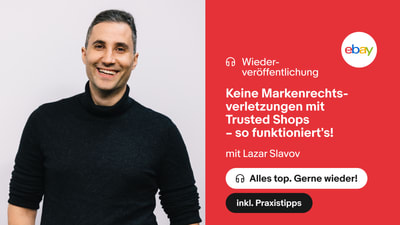
Summer break? Not for trademark law! Sounds dramatic – but it’s true: in e-commerce, trademark law unfortunately never takes a vacation, and even small mistakes with logos, product descriptions, or marketing can lead to costly cease-and-desist letters.
So this doesn’t happen to you, we’re bringing this episode out of the archive: in it, Lazar Slavov, Senior Legal Consultant at Trusted Shops and lawyer at Föhlisch Rechtsanwälte, explains what you need to pay attention to so you can continue trading safely and successfully on eBay.
And brand new since the recording with Lazar: our free legal advice with Trusted Shops – including on GDPR, AI law, trademark law & co. You can find out more in this episode, so be sure to listen in!
**Important links**
- More information on free legal advice from Trusted Shops
- More information from Trusted Shops on protecting your eBay shops
- More information on Cease-and-desist protection Basic and Privacy 360 from Trusted Shops
- Trusted Shops product overview
- Föhlisch Rechtsanwälte for e-commerce law
- The German Patent and Trade Mark Office (DPMA)
- Trademark search at the DPMA
- Trademark search at EUIPO
- More info on eBay Open
- eBay Community
- eBay for Business on Facebook
- eBay for Business on Instagram
- More info on the eBay podcast “Alles top. Gerne wieder!” and our podcast hosts
**Mentioned podcast episodes**
** Chapter markers **
- 00:00:00 to 00:00:42: Intro
- 00:00:42 to 00:01:33: Note on the new free legal advice with Trusted Shops
- 00:01:33 to 00:04:34: What support do Trusted Shops products offer retailers and how do they work with eBay?
- 00:04:34 to 00:07:42: What is trademark law and what types are there?
- 00:07:42 to 00:10:24: Why is trademark law relevant for sellers on eBay?
- 00:10:24 to 00:11:26: Who can send me a cease-and-desist letter?
- 00:11:26 to 00:16:00: What should I do if I’ve received a cease-and-desist letter?
- 00:16:00 to 00:22:08: What are the classic pitfalls in trademark law and how do I sell branded products without getting a cease-and-desist letter? (Part I)
- 00:22:08 to 00:23:46: Note on eBay Open 2025 incl. voucher code
- 00:23:46 to 00:32:08: What are the classic pitfalls in trademark law and how do I sell branded products without getting a cease-and-desist letter? (Part II)
- 00:32:08 to 00:33:21: Outro
Announcer: Well then, let’s get started, Lisa. Tell us about the new legal advice!
Lisa: In cooperation with Trusted Shops and the law firm Föhlisch, we are now offering all eBay shop subscribers access to free legal advice on key e-commerce topics, such as GDPR, AI law, trademark law, or competition law. In other words, everything that keeps you busy day to day. The session takes place digitally via Microsoft Teams and lasts 30 minutes. But be careful: the consultation is limited to once per seller. So it’s important that you prepare well for the session so you can get all your questions answered! Curious? Then check out the landing page in the show notes. There you can sign up for the consultation in just a few steps. Good luck!
Announcer: Thanks, Lisa! And now it’s on with Lazar and all the tips about trademark law. Enjoy!
Vincent: Welcome to another episode of "Alles top. Gerne wieder!" - the eBay podcast about commerce and e-commerce. I’m Vincent Rek, your host for today’s episode, and next to me is my dear co-host, Isabell Butterwegge. As you already heard in the intro, today we’re dealing with a topic that is hugely relevant for you: trademark law. How can you avoid trademark infringements? And what do you need to do to properly protect yourself in your online shop?
Isabell: Yes, that’s exactly what we’re clarifying today, and for that we’ve invited an expert: Lazar Slavov. Lazar is Senior Legal Consultant at our partner Trusted Shops and specializes in trademark law. And he’s also a lawyer at Trusted Shops’ partner law firm: Föhlisch Rechtsanwälte. Föhlisch Rechtsanwälte offer individual legal solutions and legal advice in e-commerce. Hi and welcome to the studio, Lazar!
Lazar: Yes, thank you very much! I’m really happy to be here and to talk with you about this exciting topic.
Isabell: We’re also very happy that you’re here today. And before we dive into the topic, could you explain what exactly you do at Trusted Shops for online sellers?
Lazar: Yes, of course! Trusted Shops is known to most people more for its certification services, meaning above all the seal of approval that many shops know. But our unit "Legal Services," where I also work, has been offering various legal advisory services related to e-commerce for almost ten years now, or exactly ten years to be precise. And that also concerns the topic of cease-and-desist protection, because unfortunately the issue of cease-and-desist letters is still a major annoyance for those affected, and that’s why cease-and-desist protection is so important. Trusted Shops is a partner of eBay in this area and also in the area of legal certainty in e-commerce, but above all in the area of cease-and-desist protection.
Vincent: Can you tell us a bit more about the service package "Cease-and-desist protection Basic" and "Privacy 360"? That’s basically where you’re involved with us.
Lazar: Yes, of course. The "Basic" package primarily includes legal texts, meaning the option for sellers to obtain the texts they need free of charge: terms and conditions, privacy policy, and so on. It also includes various services in the area of data protection. That means various things that are important under the General Data Protection Regulation and where sellers need to be protected, so that no authorities come knocking and potentially cause problems.
Isabell: That’s also the package that sellers get with a shop subscription from us, right?
Lazar: That’s correct. So all eBay sellers benefit from this package at no additional cost and still have these services, and above all the cease-and-desist protection service, and are then a bit better protected, or significantly better protected, when it comes to annoying cease-and-desist letters.
Vincent: As always, we’ll link further information on this in the show notes. Lazar, briefly and simply: what actually is trademark law?
Lazar: Yes, so a trademark protects product identifiers for goods and services for the purpose of distinguishing them. That’s basically the technical side. But of course a trademark is much more than just a means of distinction. Many speak of a communication sign with its own personality, which conveys not only information but also feelings. And from the legal side, one would say that a trademark is tied to an exclusive right. That means the right to forbid third parties from using similar or identical signs for similar or identical products in business. Now, creating a trademark requires a certain registration process. This registration process is a bit of paperwork, but it is important, and before filing, as a potential trademark owner, you should ask yourself a few questions. For example: what exactly are my products? Where exactly do I want to position myself? What does my "corporate identity" look like? In other words, what should my company’s brand look like exactly? And also very important: where do I want to position myself? Which market? Is it only Germany? Is it the EU? Or potentially a third country outside the EU? These are all questions that matter before filing a trademark, and of course, last but not least, this process takes about two to three months until the trademark is actually registered and enjoys protection. Although protection begins once the application is filed.
Isabell: You just said that a trademark is basically a means of communication for personality, which I think is a very nice expression. What different types are there?
Lazar: Yes, that’s a good question. In fact, a trademark can be any conceivable sign. So think of letters, words, images, 3D designs, and much more. There are also, for example, sound marks, and even scent marks. For example, one could think of the well-known film production company...
Vincent: "Metro-Goldwyn-Mayer," you mean?
Lazar: "Metro-Goldwyn-Mayer," exactly! They’re known for trying to register such a sound mark, namely the roar of a lion. So the roar of a lion was actually supposed to be protected as a trademark. That didn’t work at the time. But today you can very well imagine that it actually would work. And, for example, there was a trademark for the smell of freshly cut grass. They actually managed that as a trademark. So many things can be a trademark, but there is an important limit. And that limit is the distinguishing function of the trademark. That means not absolutely everything can be a trademark. Think, for example, of "Apple." You can use "Apple" as a term, but you can’t register it as a trademark in the fruit and vegetable category. That wouldn’t work. But as we know very well today, "Apple" works very well in the field of hardware and software and has become quite well established, as some would say. So the distinguishing function is the most important thing in a trademark. Or the trademark "fork" couldn’t exist for eating utensils, but it certainly could for a podcast entertainment service.
Isabell: And why is trademark law such a relevant topic for sellers on eBay?
Lazar: Well, third-party brands are used very frequently. They’re used in connection with original products, of course, but also as part of advertising. On eBay in particular, there’s an issue that comes up again and again, namely the sale of replacement parts and accessories from third-party manufacturers in connection with well-known brands. And with this topic, caution is actually required, because it may be that the distinction from the original manufacturer doesn’t quite work, and therefore a cease-and-desist letter is ultimately issued. In that respect, this topic is very relevant, especially on eBay.
Isabell: Then let’s assume I’ve just used a third-party brand in my eBay shop without permission. So let’s assume I’m starting, or want to start, selling accessories for "Dyson," since you just mentioned that example. What’s the worst that could happen to me?
Lazar: Yes, first of all you really have to ask yourself: could it be that trademark use may be permissible even without consent? That is quite conceivable. But let’s say we have problematic trademark use, then a cease-and-desist letter can be issued very quickly.
Isabell: From the brand, then?
Lazar: From... exactly, from the trademark owners, especially when it comes to trademark law. And that means a cease-and-desist declaration is demanded, and that should be submitted under certain obligations. In addition, payment claims are also asserted. This often involves reimbursement of legal fees, but also claims for damages. And questions come into play such as: “Okay, how long did I actually use this third-party brand in my shop?” or “What profits, what turnover did I generate from it?” Those are the kinds of questions that arise in a very unpleasant cease-and-desist letter.
Isabell: Can you explain again what exactly the difference is between a cease-and-desist letter and a claim for damages?
Lazar: Well, damages are basically one of many claims that can be asserted with a cease-and-desist letter. In other words, you have to imagine that the cease-and-desist letter itself is, in principle, even supposed to help the party being warned. It should be a tool to avoid court proceedings. The cease-and-desist letter itself contains various claims. It can be the claim for injunctive relief, that is, this cease-and-desist declaration. But it can also be a payment claim, such as damages or reimbursement of legal fees. That often happens with a cease-and-desist letter. Important to know: a cease-and-desist letter, which many people may not yet fully know, does not necessarily have to be in writing; in fact, there is no specific form for a cease-and-desist letter. It can be issued by email, and theoretically it could even be issued orally. And unfortunately, it has the same effect. You always have to be careful because it can get expensive.
Vincent: If we now take the seller’s perspective: you already said that this can happen informally. But who could actually send me such a cease-and-desist letter?
Lazar: Yes, that’s a good question. And it depends a bit on which area of law we’re talking about. So think of trademark law, which is what we’re dealing with here. Then it is mainly the trademark owners, i.e. the rights holders or also holders of license rights, of exclusive license rights. In competition law, where it’s about various information obligations or a wrong legal notice and so on, it can mainly be competitors and certain trade associations that also issue cease-and-desist letters. In addition, certain organizations, called "qualified entities," can also do this, and that’s, for example, the consumer association. So there are actors who could actually, in individual cases, send sellers a cease-and-desist letter.
Isabell: Yes, for anyone who wants to go deeper into that, we also had an episode with an internal expert on the topic of cease-and-desist letters some time ago. It was very good; we’d add it to the show notes again if someone wants to dive deeper into that.
Vincent: Then let’s talk about the worst-case scenario. I’ve actually received a cease-and-desist letter. What happens now?
Lazar: Well, what you definitely mustn’t, and shouldn’t, do is simply submit that cease-and-desist declaration we talked about. That means, without checking it first. Because these cease-and-desist agreements — that’s how one should start talking about them — are long. There is no fixed duration, and they are very broadly worded. So you mustn’t do that. You also mustn’t simply ignore the deadlines in a cease-and-desist letter. Those are deadlines that should be taken seriously. Ideally, you should definitely get advice beforehand to see what defense options exist in the individual case. That’s important because, if we think of trademark law, it immediately raises certain questions for us who deal with it, and these are important for a defense. For example: is the warning party actually the rights holder? Or is someone issuing the warning who may not even have trademark rights? Is the allegedly infringing mark actually being used? That’s an important question, because in trademark law there is so-called grace period, or use grace period. That means a trademark does not necessarily have to be used within five years after registration for the trademark to be established. That’s kind of the idea. But once those five years are over, the trademark must be used. And if it isn’t, then, among other things, the trademark owner may not take action against third parties based on that trademark. And so that also has to be checked. Of course, you should also look at the substance: what trademark is it? Is there a risk of confusion with the sign being challenged, or not? Does the trademark issuing the warning actually have distinctiveness, or not? So, questions upon questions. And so I can only say: for those affected, an initial consultation is definitely worthwhile in order to keep the possible consequences of a cease-and-desist letter as low as possible, or perhaps avoid them entirely.
Isabell: How exactly do you help in such cases at Trusted Shops?
Lazar: Exactly, Trusted Shops has, on the one hand, the option of cease-and-desist protection. That means that for affected shops that are members of Trusted Shops and have a legal product, a cease-and-desist letter is reviewed and forwarded directly to Trusted Shops’ partner law firm, Föhlisch Rechtsanwälte, and defended from there as well. This means those affected don’t have their own legal fees, and everything that’s done, all correspondence, is handled by lawyers without additional costs. That’s of course a real added value, because especially in trademark law the amounts in dispute are very high. And the potential cease-and-desist costs could actually skyrocket, and that’s one thing. The other thing these Trusted Shops packages offer is various advisory services. For example, there’s a basic legal review, which is very important because it’s about securing your own shop. So various things are checked to see whether the particular website is actually secure. That means: how are the legal texts integrated? Have they properly become part of the contract? What about information obligations? What about the design of the ordering process? All the way to the order page, where we then know this button, namely the buy button or order button — how is it labeled? Is that correct and so on? In other words, all these questions are checked. And in trademark law, for example, you look at whether certain notice-of-rights symbols are being used. That includes, for example, the "R" in a circle that you know from trademarks. You can’t just put that there, even if it looks pretty good; you have to make sure you’re not using it misleadingly, and that is also...
Isabell: The copyright symbol, right?
Lazar: That too! And in trademark law it’s the "R" in a circle, and also "TM." There’s a trademark symbol. Things that you know, but if you’re not quite sure, okay, can I actually use that and just slap it on my products? You should also get advice on that. Trusted Shops’ packages do that too.
Isabell: So that means you help, on the one hand, before a cease-and-desist letter happens, meaning you advise along the whole process, but also in case it does come to a cease-and-desist letter?
Lazar: Correct, and in fact prevention is the main focus.
Isabell: Before we hear more about the pitfalls in trademark law, we want to know from you out there: have you ever had problems with trademark law? Feel free to tell us about your experiences! If you listen to us in the Spotify app, you can interact with us directly via the Q&A function in the app. Just pull the slider up from the bottom edge in the app and off you go. Alternatively, you’re also welcome to write to us in the eBay Community or on our Facebook page "eBay for Business Deutschland." We look forward to your stories and of course to your feedback on our podcast, and of course to a like or a subscription wherever you’re listening to us right now.
Vincent: And now let’s talk about classic pitfalls and misconceptions in trademark law. You’ve certainly experienced quite a lot in your time at Trusted Shops. What’s the classic in trademark law?
Lazar: Yes, it often happens that people or shops use certain terms or designations without giving much thought to whether trademark protection might still exist behind them. Because you have to imagine that in trademark law one question is particularly important: am I using a term or designation purely descriptively, purely decoratively, as they say? And that means unproblematic from a legal perspective. Or am I potentially committing trademark infringement? And there are classic cases, for example think of "Tempo" or "Flip Flops." Both are actually protected trademarks; I wouldn’t have thought that at first either, especially not with "Flip Flops," but that is the case. So if you use the trademark to sell "Flip Flops," the question is: can I say "Flip Flops" now, or do I need to use something else? And one has to say that a trademark can actually develop over time into a common term, a generic term. If that happens, the trademark may lose protection.
Isabell: And who decides that?
Lazar: Exactly, now it’s very important to say that this only happens if the trademark owner first remains passive, meaning takes no action whatsoever to defend the trademark. Then, as you say, who decides? That could be the office, the trademark office, and potentially also a court if it comes to proceedings. But it’s important that this can only happen if it is actually demonstrably true that the respective trademark owners did nothing about it. And that’s difficult. So most people do take action. For example, "Tempo" is indeed a trademark. You have to be careful when using the word in relation to, say, tissues, and the same goes for "Flip Flops." That’s why many shops would actually use "toe separators" instead of "flip flops" to avoid potential issues.
Vincent: Is that something that even needs to be checked from a seller’s perspective? Can you determine that yourself?
Lazar: It’s actually difficult to check directly. If there’s any uncertainty or if you’ve seen that a term could potentially be problematic, it’s worth getting advice. And if a potential cease-and-desist letter comes up, that doesn’t automatically mean it’s justified. There are actually aspects that really make it worthwhile to check in advance. For example, take the game "Mensch ärgere Dich nicht!" — also a very general term. Of course, in a private setting you can play it without any problems. But if you’re selling a game on eBay and name it that, then we’re back in a problematic area, because that too is a protected trademark. But the question is whether there is an infringement in every case. What if, for example, I have a game and only refer to "Mensch ärgere Dich nicht" and just want to say this game is conceptually very similar to "Mensch ärgere Dich nicht"? Is that also an infringement? These are questions that need to be clarified by someone.
Vincent: What probably many people are thinking now is: how do I actually sell a branded product? So if I want to sell my branded drill, how can I do that without using the brand name that, of course, I want to use?
Lazar: Yes, a legitimate, legitimate question. It works! So yes, it is actually desired that original products be resold. That’s called exhaustion in trademark law. So when exhaustion occurs, you may continue distributing an original product. In that case, you can use the word mark, meaning the designation involved, the one you mentioned, for example for the drill. That is allowed in relation to the offer. Caution is required with the logo, because the logo creates a different situation. If the logo is used not directly in the offer but somewhere else in the shop, for example in a photo or somewhere else just for advertising, that can be problematic again. Otherwise, however, it is allowed to sell original goods, with certain small exceptions. For example, if a product is intended exclusively for the USA and for sale there, and then somehow makes its way to the EU or Germany, i.e. parallel import, that’s a case where exhaustion has not occurred. And that means that even with original goods, trademark infringement may exist.
Isabell: But you just said that as a trademark owner, I can or should think in advance about whether my trademark is protected only in Germany or only in the EU. So if I decide to protect my trademark only in Germany and it is then sold somewhere else in the EU, then has no trademark infringement been committed by that person?
Lazar: Yes, you mean the case where you have your own trademark, and it is also protected in the EU, for example. Then you may, so to speak, take action against third parties who use the trademark in the EU based on that EU trademark. The problematic case is if you take a third-party trademark, for example an original product bearing a third-party trademark, but you didn’t know that this product was not intended for sale in the EU at all, but actually only in the USA. It looks different, it’s packaged differently, and so on. You can’t always know that. But if you sell it in the EU, then the affected trademark owner could take action based on that and potentially assert trademark infringement. And that is what should be avoided.
Vincent: I think there’s also the keyword territorial principle.
Lazar: Correct, yes! So that’s basically the basis of the trademark. A trademark, in principle, only enjoys protection where it was filed. So, for example, a German trademark is protected only in Germany. That’s a good keyword, or a good point, because of course it can happen that exactly the same trademark is registered in Austria, while you have it in Germany but haven’t secured an EU trademark. Then it may well be that Austrian sellers don’t just grab the trademark but also register it as a trademark. That’s the territorial principle.
Lisa: The podcast continues in a moment. But you’ve probably already heard: our eBay Open is back. After a two-year break, I’m very happy to invite you again to eBay Open, our biggest seller event of the year. Celebrate with us a day full of inspiration, networking, and growth opportunities for your business, and 30 years of eBay. When and where exactly is it happening? On September 25, 2025 from 9:30 a.m. at BrewDog Dog Tap Keynote on the strategy of eBay Germany and eBay in general. Under the theme “Embrace the Future with AI,” we’ll take a look at artificial intelligence as a future trend and how it will accompany us. We’ll provide insights into the market and look at Gen Z together, because that’s a target group we should all feel closer to. We’ve prepared many masterclasses for you, where you can take away lots of knowledge for your eBay business. And we also want to give you the chance to network with others. So learning from one another is the goal of eBay Open and a fantastic reason to simply buy a ticket and come along. We’ll round off the day with a small party. And for you as a loyal listener of this podcast, we even have a code. With it you get 10% off the ticket price. The code is “ATGW10”, Alles top. Gerne wieder! 10. Tickets can be found at “eBay.de/events/ebay-open. And now hurry up, buy your tickets, and enjoy the rest of the podcast!
Vincent: You briefly mentioned at the beginning that there are also special features when it comes to accessories and spare parts. What does it look like if I also want to sell accessories or spare parts for my branded drill?
Lazar: That’s a classic, actually, especially on third-party platforms like eBay. It’s often done, and the general view is that this is actually permissible in principle; this downstream market must be protected. That means I’m actually allowed to sell accessories for original brands, but from third-party manufacturers. But now it depends a bit: the use of this third-party brand must then be necessary and must correspond to trade practices, as they say in trademark law. In plain terms, that means it’s best to use only the word mark and not the logo. That really is the first rule. Then you’re closer to what is necessary. And you also have to differentiate. How do you do that? First of all, with additions such as “suitable for” or “compatible with.” So I sell accessories for some original product and say it is suitable for brand X or compatible with brand Y. The key thing is how do I make sure that outside third parties, the customers, don’t get the idea that I’m somehow affiliated, commercially affiliated, with the original manufacturer. That must be avoided. So what do you do? You should not only name the actual manufacturer, the third-party manufacturer behind it, but highlight it as much as possible, somehow make it clear that this is a third-party product. It’s not an original product and we as sellers have no connection, no business relationship with the original brand. That’s how you create the distinction and hopefully also avoid cease-and-desist letters in individual cases, which we’ve unfortunately seen a lot of in this area.
Vincent: So, to summarize, you could also say that it’s much stricter here than when selling original products, because this, let’s say, we always call it “brand affiliation,” not...
Lazar: Yes, that’s correct, and the reason is probably that with accessories that do not come from the original product, not from the original manufacturer, strictly speaking it is not an "original product" in quotation marks in that sense; it is already a product that is suitable for use with an original product. And that’s why, as you say, it is a bit stricter there, even though one still tries to ensure that, in trademark law, there is a statutory exception, namely the exception that this market must be protected, and if everything fits, then it is also permissible.
Vincent: Then let’s move on to marketing. What if I want to do marketing for my shop now? For example, I want to show that there are many certain branded products with me or maybe rare branded products are currently available with me. What do I need to pay attention to here?
Lazar: Yes, exactly that is, so keyword, you would for example simply present various logos in the shop footer because you know I sell original goods, which shouldn’t actually be a problem. But it can indeed become a problem, because the European Court of Justice once determined that a trademark has various functions, and one of these functions is the so-called advertising function. That means it can very well be that if I place the logo of a particular company, a well-known company, very prominently somewhere in the footer, then the so-called appreciation or distinctiveness of this sign may be exploited, or rather that I profit from this advertising effect. If this boundary is crossed, one can potentially speak of trademark infringement, even if we have to say there are no fake products there, no fake products. It often concerns original goods. But the advertising function can be infringed. So caution is also required there, especially when logos or the logo are being used. In such cases I would generally recommend, if it is not clear whether consent exists or not, to get advice once to see whether it could be problematic at all. Maybe in the individual case it’s not problematic. But, as one unfortunately often has to say, it depends a bit on how the design appears and what exactly is being presented.
Isabell: That’s always our legal colleagues’ favorite answer: “It depends.”
Lazar: Unfortunately, yes.
Isabell: Okay, I’d like to try again to summarize everything we’ve discussed, which was a lot of input: you said I can’t just sell any product however I like, and caution is especially required with original products. If in doubt, always clarify in advance to what extent I may already have committed trademark infringement. Be sure to label spare parts as such, and ideally don’t use logos of brands with which I have no relationship. Can you summarize again what small online sellers can do if they don’t have a legal department at hand? How can they actively protect themselves against trademark infringements?
Lazar: Yes, for example through a Trusted Shops product, that would be one possibility, because that includes exactly this option of cease-and-desist protection and, as you said, a lot also happens in the prevention area so that, hopefully, it doesn’t even come to a cease-and-desist letter. But apart from that, it is above all important to look at: okay, am I using third-party brands in my shop, on my site? If so, which is very often the case: how am I doing that? Is it only that I sell original products and therefore need the brand? Or do I also use it as part of advertising in various ways? If I do that, then I enter an area where, at least in advance, depending on the situation, I have to check whether this could be an issue in my case. If so, what can I do about it? And that’s where it really pays to get advice in advance. And one should also perhaps consult with the supplier, because often, as we discussed, there is the issue of the distribution channel and potentially no exhaustion, therefore infringement. The supply chain is important, and you should check with the supplier whether you can determine: is it a supplier listed by the original manufacturer? Where exactly does the goods come from? What does the chain look like? Can it be proven that my original product actually comes from the EU and is intended for the EU? Or is it really goods intended exclusively for Canada, for example, and not for the EU at all? These are the kinds of questions that are important.
Isabell: Okay, and I think these are also the kinds of questions a layperson can’t just check on the fly. So it probably really is worth getting a legal expert involved before I sell online, so that everything can be checked from A to Z, from the supply route to the product to: “What exactly should I write about it?”
Lazar: Experience shows that. Experience actually shows that in many cases it is more practical and saves a lot of potential effort, and nerves above all for those affected, if it is relatively clear in advance: okay, I’m allowed to do this and that, but I’m not allowed to do that, better not, and then I potentially save myself high legal costs, possible damages claims, and so on. Most of that can actually be avoided.
Isabell: Is there any way for me to find out myself whether a term I use is protected by trademark law?
Lazar: There is. You can actually freely look at the so-called trademark registers. That means specific terms can be checked through the DPMA register. In Germany, for example, that’s the German Patent and Trade Mark Office, and it’s publicly accessible. And via a link, you could do what’s called an identity search there. So, especially if I want to establish my own brand, it definitely makes sense to at least check in advance whether others may already have come up with exactly that sign and filed it. There are even similarity searches, which go a step further and are not done by yourself, but by specialized companies. The aim there is to discover whether there are already similar signs that could be problematic and from which attacks could then come.
Isabell: But that would again mean external help, basically?
Lazar: Unfortunately, yes.
Vincent: Yes, we’ll of course also link the DPMA in the show notes. We always end our podcast episodes with the final question: Lazar, what did you buy most recently?
Lazar: Actually, it was a small toy, I think, for a boy we visited for his birthday. And that was, what exactly was it? It was some little game, but not "Mensch ärgere Dich nicht," mind you, it was a game, I don’t remember which one anymore, but yes, and it went down well, definitely, and was cheap and without trademark issues.
Vincent: Yes, that’s great!
Isabell: You probably pay double attention to that when buying, too.
Lazar: Yes, you’re a bit damaged by it, you have to admit that.
Vincent: Yes, thank you very much, Lazar. That was incredibly informative. And I think our sellers have gotten a very comprehensive picture of what trademark law is and why it is so relevant in online commerce and why you shouldn’t get into trouble here. And for anyone who needs more information, our show notes will have all the key information and links we discussed today. And anyone else who needs help should contact Lazar.
Lazar: Happy to be contacted!
Vincent: Lazar, thank you very much for being here.
Lazar: Thank you very much to you too!
Isabell: Thanks as well!

lalli666
·11 months agourgent help with copyright infringement,
I HAVE already written several e-mails !!!!!! but nobody is interested. Here is a shop seller who simply sells my art and also with several PICTURES!!!! And the best part is that according to my research all the PICTURES are stolen from artists that he offers in his shop!!!!!
You can’t reach anyone here, nobody replies!!!!!!!
This is this FRAUDSTER!!!!!! WHAT IS EBAY SUPPOSED TO PROTECT?????? do nothing, they!!!!! no reply from EBAY!!!!!!!!!