
Winning and retaining regular customers – here's how to do it! [Republishing]
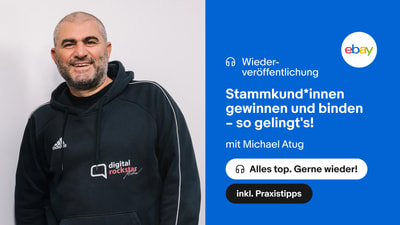
Just because it’s summer break doesn’t mean you have to miss out on a good podcast!
That’s exactly why we pulled this episode out of the archive and called our guest, eBay veteran and multichannel expert Michael Atug, once again to ask: What has changed since the recording?
It turns out the topic is still highly relevant. Because nothing is better than customers who don’t just buy from you once, but become regulars and recommend your business because they’re thrilled with your offering and outstanding service.
In this episode, he tells you how to build that kind of loyalty, how to deal with negative feedback, and how to protect yourself from buyers who want to take advantage of your service.
We hope you enjoy listening!
**Important links**
- Information on the shop newsletter
- Information on social sharing
- Information on the eBay shop subscription
- eBay Community
- eBay for Business on Facebook
- eBay for Business on Instagram
- More info on the eBay podcast “Everything top. Gladly again!” and our podcast hosts
**Mentioned podcast episodes**
** Chapter markers **
- 00:00:00 to 00:00:32: Intro
- 00:00:32 to 00:04:44: Follow-up: What has changed since the recording, Micha?
- 00:04:44 to 00:06:47: Intro
- 00:06:47 to 00:21:15: What do customers expect from my service today and how do I build loyalty?
- 00:21:15 to 00:25:25: How do I use my customers’ feedback to improve my service?
- 00:25:25 to 00:29:35: How do I deal with negative feedback?
- 00:29:35 to 00:31:02: Unfair feedback: When and how do I draw a line?
KI-Host : Then let’s see what Micha has to say. Lisa, give him a call!
Lisa : Hey Micha, it’s Lisa! Great that you picked up. Do you have a minute for me?
Micha : Phew... right in the middle of moving. Really bad timing, actually. The plumber’s coming any minute. But for you... what can I say? What’s up?
Lisa : It’s about the re-release of our podcast episode we recorded some time ago, which I thought was super cool. And I’d really like to talk to you about it again.
Micha : Was that the one about customer loyalty?
Lisa : Exactly that one!
Micha : Wow, that one was awesome. Okay, come on, I’ve got a minute. Go ahead!
Lisa : In your view, what has changed in the area of customer loyalty since that podcast episode?
Micha : Well, I’d say, basically everything has stayed the same. So the episode is actually more relevant than ever. The problem is and remains that customer loyalty is important. We need that customer loyalty somewhere along the line, because if you have to start from scratch every time, that sucks. Ideally, you want someone you already have. In the long run, that also saves you a ton of money instead of constantly having to win new customers.
Lisa : One thing you mentioned was the shop newsletter and that you could really use it more regularly again. Has anything happened with that on your end?
Micha : Yeah, I even told my team that on purpose. The only problem I see is that sometimes it gets a bit loveless, you just shove something in there like, “Well, I did that.” But really, you should take a little time and make it a bit cooler and nicer. There’s actually a lot in there. Right now we’re selling a lot of safety shoes that have simply gotten old. At some point they have to get out of the warehouse, and that works really well. You can really just click everything together easily and do it. So for us that’s a no-brainer — definitely works, and it doesn’t even cost an extra euro, right?
Lisa : Do you also take the time to look at what new features eBay has? Have you ever tried social sharing, for example?
Micha : Oh, you know, Lieschen, it’s always the same problem. You always end up chatting, and then you’re standing there having to deliver and you’ve got 1,000 things to do. That always, always gets pushed to the back burner. And that’s really a problem because there are cool things, and I actually heard about this social sharing thing a few days ago. I didn’t really have it on my radar. For example, we have this ancient Instagram account that we don’t even use anymore. Nobody has time for blah blah blah. And I think that’s the thing where you can basically push your offers out there and link them with an eBay account. I mean, what’s the downside to just letting it run? And as far as I know, it’s free. But I guess you’re about to tell me that, or am I wrong now?
Lisa : Just like the shop newsletter, it’s also a free feature that simply helps you stay more present with your customer base. And, just like you said, you can connect your business Instagram account with your business eBay account, and then newly listed items or items from a shop can be automatically posted again and again, giving you visibility and keeping you top of mind with the people who follow you.
Micha : That’s really interesting. Not everything that’s free has to be exciting, but if it’s free and exciting, then that’s obviously really awesome!
Lisa : I saw your post about Ki Day recently, and AI is also a bit of a buzzword right now. Do you think AI and automation will help us with customer loyalty?
Micha : Yeah, I think... do I need to be an expert to answer that or to have hosted Ki Day? No, everybody knows that. Lots of people are already doing it. But it’s... I mean, working with AI now, the customer loyalty part itself... sure, you can do it with AI somehow, but maybe it still feels a bit wooden. I think that at the moment it’s still a personal thing. You still have to put some heart into it. Let’s see what it looks like in two or three years, or one or two years. I mean, things are moving so fast right now. Lisa, look at everything that’s happening. It’s just... we’ve never had anything like this before. I’ve got to go now too! The plumber’s here. I’m seriously stressed. But I always have time for you, easy as that, you know.
Lisa : Micha, I don’t want to keep you any longer. Good luck with the move, and I’m glad I’m way over here in Berlin and don’t have to help carry boxes.
Micha : Okay, bye!
Lisa : Bye!
KI-Host : Thanks, Micha! And now let’s continue with the episode.
Isabell : Hello and welcome to “Everything top. Gladly again!” the eBay podcast about retail and e-commerce. I’m Isabell Butterwegge. As just announced, today we want to talk about customer loyalty. So we’re asking the question: how exactly can repeat purchases be generated and built up?
Lisa : And for exactly this topic, we invited the perfect candidate, Michael Atug. Joining us remotely today from Wipperfürth. He has of course already proven his know-how. In our already recorded podcast episode on multichannel, which we’ll link once in the show notes, and for those of you who don’t know me yet, I’ll try to introduce the e-commerce legend. Twenty years ago, Micha found his way into online retail at eBay as a tools dealer in a brick-and-mortar store, and if I remember correctly, his apprentice pointed him to eBay back then, and that’s how it all started. Over time he became an e-commerce and multichannel expert who enjoys sharing his knowledge, including in his forum “Multichannel Rockstars,” which now has over 15,000 members. It’s always, I’d say, a very special place for exchange. Micha is also a speaker at various events, not least his own, the Multichanneldays. So first of all, hi Micha, great to have you here!
Micha Atug : Wow, what a cool introduction! Thank you very much, yes, thanks for having me back again, and I can immediately confirm what you said. Yes, that really was my very first apprentice. I’ve told that story quite a few times already. He came to me back then, that was in 2001, and said to me: “Micha, we need to sell on eBay!” I was just... and it’s still... I still have to laugh, smile, and the three words I then said, the legendary words, were: “What is eBay?” So I didn’t know it at all yet, I had no idea what he wanted from me. And yes, that really was the path into a whole new world and one I’m still very grateful for that experience.
Lisa : We’re grateful to him too, and I think by now you’ve built up enough experience for us to talk to you about the relevant topics. Customer loyalty. I know the topic is close to your heart, but maybe also for our listeners out there: why is customer loyalty so important?
Micha Atug : I’d say it has a total impact on revenue, and that’s really what you want. I want to make money. Ultimately, when I subtract everything else, what is it really about? Making money for me, for my family, for my employees, maybe for some luxury I want to treat myself to, or whatever else. And if you look at the competition out there, it’s gotten really tough, and every single correct decision counts, because in the end it decides on revenue, more revenue, great revenue, bad revenue, no revenue at all. And if you take that one step further and say: okay, acquiring new customers is really expensive these days, if you have regular customers, and that’s what we’re mainly talking about in this episode, it’s really cheap to market to them again. They may already know you, yeah, they may take notice if you send them an interesting offer, because they already know you, and that’s why I think it’s super important.
Lisa : Absolutely, and I think it’s important that we look today at how you get to that kind of customer loyalty, and I think one question I have is whether it’s important for good customer loyalty to empathize with the needs and expectations of my customers, so I can really understand what they want and how I can actually build a relationship with them?
Micha Atug : Yes, that’s probably one of, if not the most important priority, because we sellers always see ourselves as great, and we make everything possible, and our perception is just completely different, and everything changed when I started on eBay in 2001. Back then people were still cheering me on if a package even arrived at all. Yeah, that’s just how it was. If the quality was also great, then they were absolutely thrilled. Of course, that has changed completely. Customers have become extremely demanding, and online retail is primarily to blame for that, although to be honest, can you even talk about blame? Of course not, because it’s brought us all to where we are now, and that’s a good thing too. Customers simply expect much more than they did back then. If you, let me put it this way, if you get everything right from start to finish, then you’ve made it, then you have a satisfied customer. Sure, they expect that from you, but in the end you’ve still done it, and that’s all there is to it — this isn’t rocket science!
Lisa : Exactly, but I think start to finish is really important. Customer loyalty isn’t one interaction; it’s probably something you have to build into your entire sales process, right?
Micha Atug : Exactly. If you... I always say, if you really run it properly from start to finish, and I’m not talking about absolute perfectionism, but properly and well — solid — then the customer is basically already satisfied. If you then add the cherry on top... or the whipped cream on top... then it’s probably just a little bit better. But generally, yes.
Isabell : Yes, you’ve been at it since 2001 and in that time you’ve also built up a large base of regular customers yourself. What do you think are some concrete things you do quite well that make your customers come back to you again and again?
Micha Atug : Yes, this start-to-finish thing fits very well here. I think we do that pretty well. On the quality side, we also have all the cards in our hand, because from the start I decided to sell good tools, even if it’s imported goods, always making sure it’s something good, and I think that when the customer gets to the end and everything fits, then they don’t necessarily want to buy somewhere else, because they’ve had a good experience, they know what they’re getting, the price is right, the quality is right, everything was top. Then they can come back. And it’s proven that customers also feel connected, let’s say, to the values and ideals of a brand; it doesn’t always have to be a huge brand shining in the foreground. I mean, honestly, my company is not an Adidas or Nike or anything like that. That’s also the only exception I would make, where I believe people are still extremely fixated on the name. But otherwise that has changed already. So even small brands, like us in this case, or listeners, can manage to come to the forefront in such a way that people say, “Oh, I know them, they were great, that’s a good brand, they have good tools now, for example in our case,” and then you can make that happen too. So this pressure to only buy profi... or, actually, “profi” is the wrong word, those super brand names: I only really see that with a few things now, yes in certain sectors, but with many things it doesn’t matter.
Isabell : Okay, so as a small retailer, if I have top quality products, can I also manage to get someone to come back a second or even a third time? What can I do to really build long-term customer loyalty? I want a loyal customer base that comes back to me again and again over the years, ideally. Do you have a few strategies you can give us?
Micha Atug : Yes, now we have to be honest in the podcast and not just because it’s an eBay podcast say that it’s super easy on a marketplace. The problem is simply this: on a marketplace, everything is much harder. That’s just how it is, because sometimes the buyer doesn’t even know where they bought it. Or the phrase just comes out because he can never remember things very well and says: “Man, where did you buy that great hammer?” As an example, and he says: “You know, I bought it on eBay.” So that makes it a bit harder, but there are ways. So, let’s look at what’s currently going on in our company: the other day, there was a discussion: “Hey, what are we doing with the safety shoes? We need to get rid of some of them slowly, they take up a lot of space, blah blah blah.” Okay, what about that newsletter stuff? Yes, right! The newsletters, we used to do those so successfully. Yeah, why don’t we do that anymore? Yeah, somehow we just stopped thinking about it. Right, why? Now a lot of listeners will say: “What newsletters do you mean?” Yes, eBay has a feature where you can send a newsletter, and in this particular case we had heavily discounted the safety shoes and sent the newsletter to those who had subscribed to it with us — on eBay, mind you. And that’s a lot of people after so many years. Like I said, we started on eBay in 2001, and we really sold a lot. I still remember the team: “Hey man, boss! You’re right, that was awesome! Great and so on,” and we’re so tied up in our day-to-day business, always busy and running from left to right, and then we forget and overlook the important things, and that was once again such an eye-opener. Or let’s take an insert in the package. That’s allowed if it’s personalized for eBay. That means...
Isabell : What exactly do you mean by a package insert? Do you mean those packing slips that you can include a voucher code on?
Micha Atug : Exactly, basically you would... put a note in the package for eBay that says: “Hey, dear customer, thank you for your purchase, can you redeem a 10 percent code next time in our eBay shop if you want to buy again?” All of that is possible, and I mean, those are the easiest tools to bring a customer back to you and maybe a second or third time, and then it works too, then they’ll look back in on their own, and now, and now it continues. Now imagine how great it would be if we sellers were that smart, if we really dealt with this and really said: “Hey, what does eBay even offer?” Yeah, so you’ve heard two things from me where maybe someone says: “Oh, I didn’t even know that, and it doesn’t even cost money — just imagine that! It doesn’t even cost an extra euro.”
Isabell : Yes, to be clear, both functions you just mentioned are only available with a shop subscription. But we can add the links where people can read more in the show notes.
Micha Atug : Yes, so in any case the recommendation is to do that, because the shop subscription makes sense in lots of ways anyway, because I want a shop within a shop. I mean, I want to show myself somewhere too. So that was obvious to me anyway. If I want to take the next step, then it’s completely clear to me that I need to have that, and that’s why I’m saying very clearly to all listeners, and to ourselves too: think about what options I have again, what can I do? The newsletter thing, as I said, was once again such an eye-opener, just do it, and it would be amazing if you could then step in there and also have an advantage over other competitors, because they don’t even know about the option.
Lisa : And I think, to sum up a bit what you’ve said over the last few minutes, it’s also just nice when you have the customers’ attention and have them looking at your offers once, then you’re already so close to the sale that you don’t have to win them as a new customer again and can, as you said, grab them super easily at a very close point, which is just great, and I think you’ve kind of... I kind of felt reminded of the ad “You stand by your name.” With a shop subscription in the eBay shop, you also have the opportunity to market yourself as a retailer a little and put your name out there. And especially with a shop subscription, when you use the features and approach your buyers in a personalized way, then... that’s how retailer brand loyalty works on eBay — a very important point.
Micha Atug : Yes, speaking of the word personalized just now: another idea just came to me. That’s how it always is for me — bam, bam, somehow. Now imagine, I’m an angler. So. Now you’re obviously saying: “Yes, who cares?” Okay, maybe nobody, but I just want to say why I’m mentioning it. I actually only buy predatory fish items, so I fish for predatory fish here at the Bevertalsperre, mainly pike and perch — in La Palma it’s amberjack or bonito, for example. So.
Isabell : You could tell us anything now. Micha: Yeah, we can’t quite follow you.
Micha Atug : Just imagine: I fish for predatory fish and not for coarse fish, carp or the like, and I buy from that tackle shop or online fishing shop where I order the most. I’m not going to say the name now, but I’ve been buying there regularly for years. Now listen, how cool would that be — let’s spin a little here, because you want to know how I can generate regular customers or how I can make them happy again? Now I send them a physical mailing. Yes, actually a letter, a real letter in their hands, and inside they send me offers for jigs, wobblers, spinners, whatever — things for predatory fish fishing. I open that thing, take it to the couch, and not just for one evening, but probably for the next three or four evenings, and the chance of me converting is probably 90 percent. So yes, you can really do a lot, but you just have to think about what you can do, not always just do what everyone tells you or what you yourself are somehow doing in your hamster wheel, but think about it. Maybe you have a store where you can borrow a little from that, not for anglers specifically, but it’s a product where you can say: hey man, he always buys this kind, so he seems to like this and that or does this and that, maybe I can send him something. And now pay attention, dear listeners, don’t start dreaming and don’t start spinning stories and think I’m talking about 10,000 letters. No, you could also just send 2-300 and see what happens: do two come back, none at all, five, ten... and if you calculate that a bit, you’ll immediately know whether it might be worth putting money into it or not. So what I ultimately want to say: think a little, especially about personalization, I think that’s what customers really love.
Isabell : Yes, I think that’s a great idea, and that you also just think a bit outside the box, get creative yourself and come up with something new. Maybe let’s take a step back to where you even recognize who has bought from you before. On eBay we’ve now introduced a flag. That means I can also see in my orders whether this is a repeat buyer. How do you do that?
Micha Atug : Ah, for example, I didn’t even know that, but honestly I wouldn’t care at all either, because if I had to think about it and then manually check every time. It would make the hairs on the back of my neck stand up, because of course I want everything automated somewhere, and for me that would clearly be no problem with the ERP.
Isabell : Can you briefly explain what exactly an ERP is?
Micha Atug : Yes, sorry, people always say it so quickly, but not everyone knows what it means. I’d rather call it a multichannel tool here. For example, I use JTL, but there are many others, and for me the magic word is always data, data, data, because that’s where everything is in there. My items are in there, my translations are in there, my delivery notes, invoices, packing slips come out, my... I can even connect accounting to it. I... oh... you can’t even imagine what all you can do and want to do with that, and it just saves an enormous amount of labor. I’ll just call it an all-in-one tool. If you want to do that manually or with employees: it’s almost impossible. Sometimes it’s not even about money anymore, but about the fact that it wouldn’t be feasible in terms of time. Just a small example. You can say where you sell what at what price. You could say, listen, on eBay I want to sell it for, I don’t know, 20 €, on another marketplace for 23 €, in my own shop for 19 €. You can, for example, say that on eBay I don’t want it listed at all for this and that reason, and just tick the box that says you don’t want that, and that’s how you can do it. That’s really awesome. While I’m talking, though, a really cool idea is coming to me. That would actually be something for us too. What you could probably build, for example, would be a workflow that basically pops up on the customer’s second order, and then the system tells you: “Hey, watch out, Ms. Meier from Buxtehude has ordered from you for the second time.” And now just imagine the lady’s face when you put in a note, maybe signed by hand, that says: “Hello Ms. Meier, we’re delighted that you’ve ordered from us for the second time. We’ve included... I don’t know, a small bag of gummy bears,” or who knows what. Or here’s a voucher code for their third purchase or something. That would be really awesome again! The customer would be totally surprised and say, wow, how crazy are they, and that’s customer loyalty again. It actually fits quite well with the first ideas we had.
Lisa : Let’s talk again about the fact that customer loyalty simply also means continuous contact with customers. That’s bound to generate a lot of feedback that you can take on board for better offers, better selling, or also for dealing with customers. How do you then build that collected feedback you get from customer loyalty into your processes to improve the relationship?
Micha Atug : I think it’s very, very important that you question yourself and also train your employees accordingly. One of the, the, the, the, the most important things, for example, is to take learnings from feedback and not be offended or think: what does he want? Because we always have to remember... I’ll put it very bluntly with a phrase I like to use: the worm has to taste good to the fish, not to the angler. We’re blind to our own business, and we mustn’t forget that. We know the processes, we know the procedures. For us, everything is clear. We’ve become totally numb to it. That’s a completely normal process, but that’s the killer. You have to work against that. We only see our own perspective. But that’s wrong. The people asking aren’t doing it for no reason, and they’re making the effort. It matters to them, they have some point that touches them, and that’s why they ask, and that’s why it should be especially important to us sellers. And one more thing I’ve noticed again and again: the sooner you answer, the sooner you have the order in the bag. Because what stands out to me all the time now is that response times have sometimes become horrendously bad. Sometimes you wait three days if you’re lucky to get an answer. By then the customer has long since looked somewhere else, found the answer there, and poof, they’re gone. I think if you answer immediately here, you have a many times higher chance of landing the order. Let me give you an example. We had a kind of collet chuck, you have to imagine, we photographed it, and then people kept asking if they could have a picture showing the back. I first thought, what do they even want? Who cares what the thing looks like from behind? The front has the clamping bits and all that. Then we did it, sent it off, and after the tenth inquiry we finally understood: okay, why is this actually important to the customer? Yes, because they wanted to see how deep it goes in, because they wanted to check it on their lathe, and we didn’t get that. And since then, if something pops up more than three times, we say: hold on, why do customers want to know this? And then the alarm bells ring. So, we took the picture and added it, and the item sold much, much better than before.
Micha Atug : Yes, sometimes it’s the little things.
Micha Atug : Exactly, exactly, it’s often the little things. We always talk about the big things, but sometimes it’s the little things. And what’s kind of funny too... it’s more of an anecdote, really. I was recently in my second home, La Palma, and I was at a flea market, actually. I had a ton of tools and stuff lying around from renovations, and fishing gear that needed to go too, taking up a lot of space, and everything. That was one of those moments when I realized again: oh man, seeing a customer, looking them in the face, talking to them, negotiating, seeing where their pain is, what they ask for, how that is — that’s of course missing in online retail, right, and that’s a shame, but on the other hand, of course, completely normal. But questioning yourself and also maybe, as you just nicely said, Isabell, thinking outside the box, that doesn’t hurt any of us — on the contrary! I think that’s really the game changer for sometimes making things better with small means.
Lisa : Yes, and also just being close to the customer again and then drawing your conclusions from that.
Micha Atug : Totally, and how nice that was! That was so much fun!
Lisa : Before we continue talking about the topic, we have one more request for you out there. Please write to us in the eBay Community or on our eBay for Business Germany Facebook page and tell us what your success recipes are when it comes to customer loyalty, or whether you’ve been groping around in the dark up to now and are happy to be able to use Micha’s tips now.
Isabell : Yes, and feel free to give us general feedback on our podcast there too. And you know the drill: of course we’d also be very happy if you leave us a subscription or a like where you’re listening to us right now. That always helps our podcast keep growing.
Lisa : Let’s talk about a kind of feedback that may not be quite so nice when customers are not satisfied, namely negative feedback. Leaving aside whether it’s justified or not, when negative feedback comes in, how do you handle such complaints or how do you still try not to lose the customer, even if you’re annoyed yourself?
Micha Atug : So, that was really hard for me at the beginning. I had to learn that myself first, and at first I always took everything so personally. But actually the answer is relatively simple. It has nothing to do with becoming numb, but these are things... first you have to take a deep, calm breath. Yeah, first of all, don’t reply right away, first look exactly at what we wrote? Yeah, what, what is his pain even, what actually happened? There’s a reason for the Prussian night, that’s what it used to be called in the army. You can’t change a complaint or a rule or something like that on the same day; you always have to sleep on it for one night. It’s basically the same here. The next day, the world often looks different. That’s how it is, you’ve all noticed that. So look at it calmly, go have a coffee first, and then come back to it very calmly. Or let someone else answer, that’s also a good tip, you don’t have to do it yourself, just let someone look at it without prior knowledge. For example, they’ll look at it and say, what are we even talking about here? It’s 5 € for the return label, or the item only cost 17 €. Yeah, let it go, move on! Just plan a bit of budget for things like that, and then it’ll be fine. And I also say very honestly, look at what’s going on in the world out there. I mean, if you look at the news right now, do you really want to get upset about something like this? Is it really worth it? Isn’t there more important stuff than that? Yeah, so maybe sometimes just let things slide and focus on your core business. A lot of people forget that too in the time I spend rambling back and forth and writing messages — how much time does that cost me? I’d rather source a new item, maybe negotiate with a supplier, create a new listing, or who knows what. Why should I alienate customers over a few euros? I think it’s good for all of us to really get through that Prussian night.
Lisa : I thought that was a super... a super helpful tip to allocate a budget in advance and just pay for something like that out of it, have already built it into the price, and then you don’t get upset about having lost the money, potentially.
Isabell : I think you just unconsciously mentioned an important keyword, namely that it’s always only a few customers and a few individual cases where this happens. But in the pre-interview you also mentioned that you’ve actually already dealt with fraudsters. As a retailer, do I also need to keep an eye on the fact that my goodwill and the desire to build up regular customers could perhaps also be exploited?
Micha Atug : Yes, so of course you have to say that I’ve been involved since 2001, and that’s obviously a lot of time for things to happen, and the funny thing is, it’s not all fraud; sometimes it’s a demand that comes across to us sellers like blackmail, and then you just have to ask yourself again: what does the customer actually want, why do they want that, or am I maybe partly to blame after all? And in the end, does it even make sense to play the stubborn mule here? But I know how it is. Sometimes it still somehow feels good to let off steam and get your frustrations out. That’s also a crappy situation to be in. You can see that, for example... Lisa said at the beginning that the Facebook group “Multichannel Rockstars” has 15,000 people, so someone posts there, then people laugh, then people comfort each other, but sometimes you also get a slap on the wrist and someone says, “Hey, what are you... don’t get worked up over 5.50 €.” Shared sorrow is half sorrow, that has to be said. By the way, one cool thing about eBay, I’d also like to mention this. I don’t even know if everyone knows this, or many know it, but on eBay you can also block buyers. That means if I have these types, I can just say no, I don’t want to deal with them, and then I block them on eBay. You can’t do that on other marketplaces, for example. That’s a very nice feature, by the way.
Isabell : Exactly there you’re talking about a great feature. You can now control the function directly from the messaging system on eBay. That’s what you just mentioned. Micha, you kept talking about the 5 € or 5.50 €. When do I know when enough is enough? So okay, we don’t want to argue over 5 €. But what if it’s 5 € a hundred times a month, or if it’s someone where it’s sometimes about 500 € — when is enough enough?
Micha Atug : Yes, sometimes you just have to say no. That’s what I say very clearly too. I’ve had situations where I said this far and no further, because everything has its limit somewhere. We mustn’t forget one thing: we also have to feel comfortable with what we do, and now just bending over backwards for every customer because, even though you know it’s not correct, what they’re doing crosses a line. Yes, I’ve been insulted. So honestly, you also have to be consistent and strong enough to say no, now it’s over, I’m not doing that, and you know what, I’m actually happy to take that negative feedback, but then I look in the mirror and say: Micha, that was okay, because this far and no further. There’s a limit somewhere. And if you ask me how you know where that is: I actually think one of my favorite words, or two words, is “somatic intelligence.” That simply means gut feeling. You just notice when boundaries are being crossed and you simply no longer feel comfortable, and you see it’s going too far. Then you draw a line and say no, now it’s over, and you simply listen to your gut, and then you’ve... actually found the solution.
Lisa : Micha, to sum up, you should think outside the box based on your gut feeling, put yourself in the customers’ shoes and use that to generate your learnings, stay in contact, and look at what eBay offers there so I can reach my customers again who have already bought from my shop once. For everyone, we’ll link a few more bits of information in the show notes with helpful tips on what eBay offers. But we’ve already covered a lot of that on the podcast today as well.
Isabell : Then we only have one last question for you, which you already know, dear Micha: What was the last thing you bought on eBay?
Micha Atug : Yes, a long-sleeve T-shirt from Fruit of the Loom.
Lisa : I would have expected a wobbler.
Micha Atug : No, actually not, me. It was just about to be, but I actually ordered a long-sleeve in royal blue.
Lisa : Then let’s see whether we’ll see you soon at geh.digital in a royal-blue Fruit of the Loom long-sleeve, Micha. Thank you so, so much for taking the time today and for informing our listeners with your tips and really exemplary advice about why customer loyalty is so important and what you can do in concrete terms. We’re looking forward to seeing you by June at the latest, and hopefully many of our listeners are too. geh.digital once again, come by, network with each other, and we’re looking forward to seeing you and me, until then!
Micha Atug : Bye, thank you very much.
Isabell : Bye!

