
What a year! Linde Scheers and Oliver Klinck from eBay look back and ahead
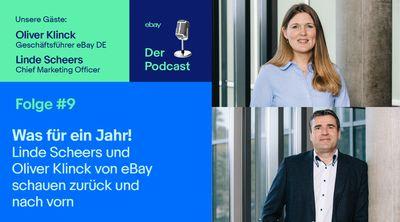
An eventful year is coming to an end. Time for a look back at the last 12 months and a look ahead to 2022. Joining us are Oliver Klinck, Managing Director of eBay Germany, and Chief Marketing Officer Linde Scheers. What have we achieved together for sellers? Where do we need to improve and what do we want to achieve next year? Look forward to exciting insights into the work of the eBay team.
**Important links**
Isabell: Hello and a warm welcome, dear listeners, to our very last podcast episode of the year. We’re heading toward the holidays in huge strides, and you, dear sellers, have probably almost gotten through the most stressful time of the whole year. Today we want to take the time to look back together on the past year.
David: Exactly, Isabel. Hello from my side, David here. Somehow the end of the year always comes very suddenly. All the more exciting to take a look at what actually happened with us over the whole year. For that, we invited two guests today who can of course tell that best of all. Welcome Linde Scheers, Chief Marketing Officer at eBay, and Oliver Klinck, our Germany head. At this point, it should also be said that we are of course very aware of the current corona situation at eBay and therefore can’t all sit here together in the studio. We very much hope that we can maintain our good sound quality, but if anyone notices, you’ll know why it may sound a little different today. But now hello to everyone?
Linde Scheers: Hello everyone.
Oliver Klinck: Hello everyone.
Isabell: Linde, our listeners have certainly heard your name before, but we don’t want to break our podcast tradition and I’d still like to ask you to say a few words about yourself.
Linde Scheers: Very gladly, Isabell. So I’ve now been with eBay for a year as Chief Marketing Officer for Germany, and before that I worked at N26, a mobile bank, where I led global communications. And before that I spent 10 years at Google in various sales and marketing roles. I’m originally from Belgium, but I partly grew up in Germany and over the last few years I’ve lived and worked in a total of 7 different countries in Europe and Asia, so I’ve had a pretty international career path.
David: Thank you, Linde. Oliver, of course the introduction tradition applies to you too, so you can tell us a few words about yourself and your career path.
Oliver Klinck: Of course, gladly. I’ll say up front that I’m a bit older than Linde and can therefore already say that I’ve now been in e-commerce for over 20 years. My start was at a joint venture between Axel Springer and Otto building a women’s portal. Classic startup, building everything from scratch, was an insanely exciting time, especially as a start, and over the last 20 years it’s been many different stops within the Otto Group, within Office Depot, and for the last three years at eBay. And I’ve had the pleasure of really getting to know e-commerce from all sides, always discovering new ones, whether it’s B2C or C2C or B2B, whether it’s sourcing in the Far East for shipping online or marketing, really end to end. And it’s always exciting.
Isabell: As announced earlier, today we want to talk with you about the past year, and I’d say we’ll get started right away, perhaps with the question of what all happened in the market this year?
Oliver Klinck: Linde, do you want to go first or should I?
Linde Scheers: You’re welcome to start, Oliver!
Oliver Klinck: Good, we’ll definitely complement each other. So I think what has affected everyone, unfortunately again this year, is the pandemic, and I mention this because the pandemic of course also has an impact on how our customers shop. So there are clear shifts; most recently we also saw it again during Cyber Week, where our customers started shopping much earlier than just on Black Friday. They’re also buying different categories at different times of the year, and in that respect what has always driven us in e-commerce, namely being very close to the customer and at the same time taking up the dynamic and acting very agilely and innovatively, was very much defined by this year too.
Linde Scheers: Yes, exactly, so the deals and discounts that now stretch through the whole of November and also flow seamlessly into December. It’s no longer just Black Friday, but Black Friday weeks, month, and so on. So that’s of course something that has changed as a trend in the market. Over the last year, and yes, I think of course Covid continues to be a major topic in the market with our customers. We also see that consumer behavior has shifted because of it. For example, sustainability has become even more top of mind for consumers because of Covid, so quite a bit has changed and moved over the last year.
Isabell: And if we now look at this specifically at eBay, what does that mean for our sellers?
Oliver Klinck: Of course, a huge adjustment, just like for us, and maybe even more so, because our sellers also have the challenge of having inventory, having to order goods, buy goods, sell goods. And Corona certainly hasn’t exactly made the environment any easier. There are increasing challenges for our sellers to get goods; processing under all the Corona requirements is also not always easy, but the Corona requirements make sense. I should say that from my side as well. But of course it doesn’t make our sellers’ lives any easier.
David: Linde, you’ve now been at eBay for just over a year. How do you view the eBay brand, and what have you and your team done in this important year?
Linde Scheers: Yes, so brand is a top topic for us, so how do I view the brand? I see incredible potential. eBay is a strong brand in the sense that many consumers know eBay, yes, so eBay is definitely top of mind for many in terms of awareness too, but it has a lot of potential, and not much has been invested in that potential for a long time, and that’s what we changed this year. We already started this in previous years as well. We focused very strongly on rebuilding the eBay brand and giving it emotional weight. From a new brand positioning that really builds on eBay’s strengths, then through a few interim brand spots, we’ve now come to a new long-term brand platform called “eBay, das seid ihr” (“eBay, that’s you”), and the first campaigns based on it have been live for over a month now. Hopefully you’ve all seen those too, and of course they also ran during Cyber Week and continued through the Christmas season, and exactly, that’s what we’ve been doing for the brand so far. Really making the brand more visible and more prominent again, and also communicating more about why eBay matters, what eBay stands for, and why people should buy and sell on eBay. But beyond that, marketing of course doesn’t stop when customers land on our site or in the app, and especially the first experiences on our site and in the app are important for long-term customer loyalty. And that’s why another focus is redesigning onboarding for new buyers and shoppers. And yes, and beyond that we’re also strongly focused on some categories and advertise there along the so-called customer journey to win more customers or, rather, move existing buyers to buy more. So those have been some of our focus topics this year.
David: That of course means very, very good things for our sellers. We’re doing a lot to make eBay more visible and, above all, more attractive to buyers. Our sellers are very happy to hear that.
Linde Scheers: Exactly, that’s how it is, yes.
Oliver Klinck: We’re already seeing that too, by the way, because of course we measure it as well. So there’s definitely still a lot to do there, and I know that Linde and her team are already very much on it, and when Linde and I talk about it, my vision is also always that I want the brand to be just as strong in the market again as “3, 2, 1 Meins” once was, and that’s why “eBay, das seid ihr” is actually a wonderful platform, because it reflects exactly where we once started 20 years ago and where we are today. We’re no longer 3, 2, 1 Meins. We are eBay, that’s you.
Isabell: We’ll come back to the marketing activities and the campaign in a moment, but Oliver, I have another question for you before we dig deeper: we are a marketplace, we’re constantly evolving, and this year many new product developments have also come into the market. What were the top product developments we got to follow this year?
Oliver Klinck: Yes, I’m not even sure how to really classify top development, meaning top in the sense of what is used most or what has driven the most impact? I’ll make it a bit random and choose three that I think will also be very important in the future and that I know we’ll continue developing. One topic is eBay Shops. We revamped eBay Shops. Until some time ago it was really only available on desktop, and of course that’s completely out of date; the biggest traffic today is on mobile, no secret there. So this change was absolutely necessary to make sure all our customers can really see our sellers’ shops, no matter whether they’re on desktop at home or on mobile. We did a lot there; I’d say we’re now more or less on par in terms of functionality. It’s important to me that our sellers can show much more of a face, and that’s not just important to me. Why is it important to me? It’s important to our buyers. They want to understand more about who they’re actually buying from. And on the other hand it’s important to our sellers because they naturally want to tell a story: Why is this their assortment, why is it their brand? We also have many offerings that set us apart, products you don’t just get everywhere, but also special products, special collections. And that’s why we need to be able to tell a story, and that’s why the Shops topic will become even more important and expanded further going forward. That’s one point. The second point, which goes in a similar direction, is that we expanded our reports on listing quality. That’s important too. Everyone knows it’s very important to understand how I should actually present my listings on eBay in order to sell successfully? That’s going to become even more important going forward. First, our buyers’ requirements are increasing, and at the same time we’re expanding our industry-specific solutions, and for that we need even more content. So the topics are: Why is a product, Linde mentioned sustainability earlier, we need to think about how to present products, why is a product sustainable? Why not? What other features does it have? So there’s going to be a lot more there, and that’s why it’s important that we also share what our sellers actually need to list in order to sell successfully with us? So listing quality report, second topic, and third topic, a classic: coupon codes. All online sellers work with vouchers, discounts, etc., and this year we made it much easier for them to create their own coupon codes as sellers so they can truly acquire customers successfully on our platform, and that’s also a topic. Maybe a bit “me too,” but very good for business, so for me that’s the third product point as well.
David: Very nice, I actually used a voucher recently too, so: it works.
Oliver Klinck: There are always people who do that, David.
David: Wonderful, let’s take a closer look at a few topics; we’ve put together a very diverse range of seller programs. What have we actually done here?
Oliver Klinck: Yes, that’s a wide potpourri of topics. I’ll start with last year, when the pandemic began, we launched the eBay Starter Program to help new sellers sell successfully on eBay. Brick-and-mortar sellers, and that was the main target group that had no online experience at all, to begin with. We continued this program this year and will continue it next year too, because we see that it works very successfully. And we know that selling online, especially for people who haven’t done it much before, isn’t that easy; it’s just a completely different kind of selling, and that’s why they need support, and there we also see good results. We continued that topic this year and also launched a support program for all existing sellers. “All” is a bit exaggerated because it’s a very personal program, enabling personal support. People, our colleagues, sit there and advise sellers. So we can’t do that for everyone. But we proceed in so-called cohorts and take in over 1,000 sellers each quarter. And we look closely at where improvements could still be made. It’s very different, but it’s personal advice tailored individually to the seller. We see a lot of positive feedback there and also clearly see that we can really contribute to improvements for most of them, though not for everyone. So the personal approach to sellers, the personal support from people and colleagues on our side, is a major pillar that we started last year, expanded strongly this year, and will continue expanding next year. Then there’s the whole eBay Community topic, David, you’re also very close to that, I know. We talked about it again at eBay Open, and that’s a big step we took this year, technically speaking, in that we really modernized the platform, and we can also see from the feedback and especially the engagement of our customers and our sellers that they’re engaging in very close exchange there. Usually, not always, but mostly the best advisor is a peer or even a competitor, because they can better understand, sometimes better than we at eBay, what solutions are actually needed, and we at eBay also regularly look in there to better understand what our sellers need. So I’d say the Community topic and the technical platform we built is another milestone. And yes, we also did eBay Open again as another point, again this year unfortunately under the Corona umbrella and therefore digital. I hope next year it’ll be a personal meeting again. We chose a completely new format, and there too a lot of the focus was on communication across a wide range of topics, and it was very well received, but I know we can’t really communicate enough.
David: You already mentioned eBay Open. Linde, how did you experience eBay Open and what does the event mean to you?
Linde Scheers: For me, it was actually the first time I was there live. Last year I was already able to take a look behind the scenes, so I think it’s a really great program. We created so much content through it that I think is also very relevant for sellers. I also took away quite a bit of new information from the sessions myself, which I thought was great. So I think having such rich content and, as Oliver already said, this constant communication is very important. And of course it shouldn’t just happen one way, so it’s important that communication doesn’t just go from us to sellers, but that exchange also happens the other way around, and that is very important to both Oliver and me, of course, that we have that exchange and keep hearing from sellers again and again.
Isabell: To now wrap up the year in review: what are the most important things you both have taken away from the year? Linde, maybe you’d like to start?
Linde Scheers: So for me, what I took away from this year—I think it’s not only relevant for this year, actually for every year—is really to always reach outward and look, to go into exchange with our customers. As I said, that applies not only to this year, but Covid has changed a lot in the market, in consumer behavior, and of course also brought completely new challenges for sellers, as Oliver just noted. And that’s why it’s all the more important to have that exchange and to really understand how we as eBay, as a platform, need to respond to this changed behavior, but also to the new needs and challenges that arise from it.
Oliver Klinck: Yes, perhaps to add from my side, I think two priorities have crystallized for me that have always been there, but have become even more important through the dynamic that has now increased in the market. One is absolute customer orientation. And when we talk about customers at eBay, we only have customers, meaning both you as sellers listening here, as well as private sellers, as well as buyers—so we only have customers—and in this dynamic it’s even more important to listen exactly to what moves our customers, what they need. Especially in the diversity in which we operate, that’s one point. Customer orientation has always been a topic and is becoming much more important in this time for us, but I think also for you as sellers. That’s one point. The second point has also always been there: in the e-commerce environment, to be fast, agile, and innovative. And I think that, together with a certain pragmatism that isn’t always there, especially in large corporations, has become even more important. Especially in this time, where we simply have to act and move very quickly without having the time to start large analyses beforehand, where we have to adapt to what the market and the customer demand from us.
David: Very good, we’ve looked back a lot now, let’s talk a bit about the present and eBay as a marketplace. Oliver, we have an incredible diversity of sellers here, as you just said. What challenges does that bring?
Oliver Klinck: Maybe first, why do we always talk about this incredible diversity? It’s actually what defines us. One of the biggest USPs we have at eBay is precisely this diversity. The diversity for the buyer is that they can actually buy everything, both the commodity product you find everywhere and the real niche product from antique to new, etc. You all know that. That only works if you really have a whole diversity of sellers. So they. And that means there are sellers from very different industries. There are sellers who are large, very large sellers, large corporations, sometimes big brands. But that’s not really what defines us, and there aren’t many of them, and they’re not the large share of what is bought from us either; instead, it’s the many small and medium-sized businesses from very different backgrounds. And by background I don’t just mean gender or the country you were born in, though that too; I mean people who started offline, then moved online, or online sellers who started online and then went offline, maybe even started in the living room at first. Yes, and then in the end started running a large warehouse. So we know, see, and value these stories. I personally always do at the eBay Awards because it especially shows what a wide range we have there, so a huge range to reinforce that again. And what are the challenges with that? We have the challenge of communication, which in my view is becoming more important and more specific all the time. We already had the topic before, because what actually moves sellers is very different depending on where they are, let’s say, at what stage of developing their business they are, what they’re selling at the moment. And that continues to increase because of regulations, it continues to increase because we have to become more and more verticalized. What does verticalization mean? We have to become more specific in which functions we offer, how we offer the goods, what our listings look like, which marketing channels we use, etc., depending on whether someone wants to buy an electronic item, say an iPhone or an Android phone or any phone or MacBook, or whether they want to buy furniture, or whether someone wants to buy a new product or wants refurbished products. All of this requires a special approach to customers, to buyers, and that also means that from our sales side we increasingly have to require specific information and specific ways of working in order to address this market precisely; in other words, complexity is increasing, while at the same time there is high diversity among our sellers.
Isabell: We’ve already talked a lot about the diversity at eBay and the challenges that result from it. Linde, what exactly does that mean for marketing?
Linde Scheers: Yes, as I said, Oliver has already said quite a bit just now. So communication is naturally a focus, yes, exactly. Within our target group we don’t just have one type of seller; there’s also this diversity, this diversity of buyers. They have different needs, different characteristics, and so on, and that’s why it’s naturally important to approach communication in a more personalized and tailored way, and at the same time I think that because it’s also a strength, we need to communicate that diversity outward as well, yes, for me that’s really a central topic in communication too. So we now have the platform eBay, that’s you. eBay, that’s them, and those are sellers, buyers, and we’ve also increasingly integrated and showcased sellers in our marketing, in our advertising, both in, let’s say, the broader communication we run and in the eBay in your city topic, where it’s very specifically about local commerce, local sellers, and local merchants, so that our customers are really at the forefront, and that includes this diversity on both the seller and buyer side.
David: You already mentioned the new brand campaign, eBay, that’s you. It launched recently. Now I’m naturally wondering, Linde: how did the idea for this campaign come about?
Linde Scheers: Yes, so maybe just a brief start: eBay, that’s you is not just a campaign, but a longer-term brand platform, and it’s based on a new brand positioning. That was maybe a bit much marketing jargon, but what I want to say is that a campaign is for a limited period, but with eBay, that’s you we will now continuously communicate in public on the channels that are relevant for our buyers. And that’s why, unlike in the past, where we often shifted back and forth and ran a certain communication for a short time and then changed it again, this is now really what we want to play continuously. The idea, to come back to your question, comes from our customers. So from our buyer, but also from our seller. So actually we developed various concepts based on this, on our brand positioning, and then discussed them with our customers, and out of that exchange eBay, that’s you emerged, so a very collaborative approach, so to speak.
Isabell: We’ve already looked at many challenges, and we’re always very open with our sellers, and we naturally want to be that today as well. Oliver, where do you currently see the biggest problems we have and what should we work on?
Oliver Klinck: Yes, I’ve already touched on some of them in my previous answers. So we do see various trends that don’t exactly make selling easier. The first trend is a growing number of regulations affecting our sellers, affecting us, simply affecting the market. For me, it’s not even about whether the regulations make sense or not, but they are definitely there and we all have to deal with them together. The second is that customer requirements are increasing. The good thing—if one can call it good because of the pandemic—is that e-commerce has naturally gotten another push. That’s the only economic advantage, let’s say, that we can take from it. But that also means that customer requirements are increasing and that new customers, especially in Germany, are very many older customers who went online for the first time and are staying online, but that also means new challenges. The next requirement is also that we at eBay don’t always make life easier, I know that, because we have to try to meet buyer expectations, and that’s something we also have to address, for example through verticalization, meaning industry-specific, category-specific applications. But that also means, as I said earlier, that there are additional requirements coming on top for them so that they can ideally sell well in the end. But those are first and foremost expanded requirements. So I’m fully aware that selling online, whether on eBay or on other platforms, is not necessarily getting easier. What do we need to do at eBay, as mentioned already: more communication, get better at onboarding. I’d say we’re not always ideal there; I think we’ve gotten better, I’m convinced of that and I hear that we’ve gotten better, but I also think we’re still a long way from what I would consider perfect. Our communication is sometimes contradictory, sometimes hard to find, when you google us, I always like doing that, and don’t go through our platform and don’t come from the inside and try to find information, it’s sometimes great. Sometimes I’d also say a horror, so there’s still a lot for us to do there. Just to give support, and maybe this isn’t just about eBay, for me too, when I look back at eBay Open for example, it was again the case that a third of the questions we received actually had nothing to do with eBay at all, but were more questions like: what do I actually need to consider from a legal perspective when I sell? What regulations are coming? So practically no eBay-specific questions at all, and that also feels like it’s increasing. The next issue is that, of course, we are ultimately a technology company. We don’t carry inventory ourselves; we have a marketplace where we basically bring buyers and sellers together. That also means the challenge for us is that we have to get better and better at what we call product solutions, meaning technical products, both in what we develop and how we introduce them, and there are also solid advances there, but there’s still a lot to do, so there is definitely plenty of work left for us too. But we’re tackling it and are fully aware that this is an issue we need to keep working on.
Isabell: You already mentioned that an important topic for our sellers is many regulations. What will come up for our sellers in 2022?
Oliver Klinck: I think the podcast would blow up if I now said, and these are all the regulations coming—well, that already says something—but I’ll pick a few. The one thing that’s coming next, in my view, is two things. One is there’s a regulation under the code word Omnibus, which will require marketplaces to show more clearly why search results are displayed the way they are and also to show more clearly who is behind the listing? Especially for marketplaces: is it a private seller, is it a commercial seller. I think that’s great, by the way. It affects you as sellers less, in the sense that we have to do something for it. I think it’s great because it highlights the diversity of the eBay marketplace even better. So I see that less as a challenge and more as an opportunity for us and for our shared business. Then there’s something like a packaging ordinance. It’s been around for a while. And it’s also not new that you have to comply with it, but what’s new is that marketplaces, and this is also a trend, are now being made responsible for ensuring that this legislation is implemented and that everyone selling with us follows the regulations of the administrative legislation. That means we have to do administrative work, we have to cooperate with them and with the sellers to, let’s say, not only check and verify their tax ID, which we already did this year, but additionally also ask for the ID for the packaging legislation and verify that too, and that’s not just gathering information, we’re also obliged to check it. That will be another administrative burden we’ll have to take on, but we’ll do it, and it comes into effect on 1 July, so that will be another issue accompanying us. And maybe jumping further ahead, although this only comes at the start of the following year, it’s also a big topic: the Electrical and Electronic Equipment Act, for example, which we have to comply with. Similar issue: we as a marketplace are being made responsible for ensuring that everything sold through us meets these requirements. In itself that’s not a bad issue at all; we’re happy to tackle it, but again it’s something we have to solve together with you as sellers. And it definitely means administrative work and complexity. So just a few challenges; that’s not everything, not comprehensive, and certainly not legal advice or regulatory advice here, but it does show how much we’ll have to address together next year as well.
David: We’ve already heard a lot about the challenges we had this year or that are coming our way. But where do you see our biggest strengths, Linde?
Linde Scheers: So I think we’ve already said quite often in our conversation: diversity, yes, so I don’t think I need to go into that any further now. So diversity of inventory, but also the unique inventory we offer. Another strength for me is, and Oliver just mentioned this too, the community, yes, the community. We bring buyers and sellers together, and over the years a strong eBay community has formed, and that is definitely a unique selling point for us as a marketplace. Another strength is that at eBay you can both buy and sell, and also sell privately. That’s also something consumers don’t really have on their radar anymore, so they often forget it, and we’re also increasingly communicating it again. And the topic of circular economy is also a core part of our company. And especially now, when sustainability is becoming more and more present for consumers, it’s gaining even more relevance. And another strength for me is that as a marketplace we also offer these economic opportunities. Anyone can sell with us and build their business, keep growing, from small local sellers to large sellers, so we offer these opportunities for everyone.
David: Of course we also want to talk with you about next year and our plans. Linde, what’s happening in marketing right now, what are your plans? Well, we can’t explain the entire marketing plan here. But what can sellers expect, what awaits them, and what have you maybe already started and want to keep pushing forward?
Linde Scheers: Well, a lot of it is actually what we’ve already built this year or where we laid the groundwork. Because in marketing, to be successful, you really have to invest very consistently and in a focused way in certain areas. You won’t achieve much impact if you start talking a little about one topic, then a few weeks later about another topic, and basically keep running this constant start-and-stop, and that’s why we’ll continue investing in eBay, that’s you, to keep building our brand and also improve onboarding and good onboarding for our customers. We’ll also keep cleaning up our communication, because there’s also a lot of room to improve there. And of course at the same time we’ll continue doing seasonal marketing. And Cyber Week, the Christmas business, etc. will of course also be strongly supported, so really everything you’ve already seen this year, but we want to improve a lot in these areas.
Isabell: Oliver, from Linde we heard that continuity and a focus on the diversity of the marketplace are at the forefront for next year. What’s at the top of the agenda for you in 2022 and what are your most important topics?
Oliver Klinck: First of all, what Linde said as well, because we are one company and everything only works if it all interlocks and is connected, so what we tell customers out there also has to be experienced on the platform, and in that respect we are of course completely synchronized. What is generally important to me from a commercial perspective for next year are two topics. One is that I’m very pleased that by also focusing on certain industries, focus being a big topic for Linde too, we can achieve a lot. The first focus we set was our auto parts and accessories business. Where we managed, despite already having a very good market position, to further expand market share and gain even more market share, and really through a focus by introducing new product features, by doing significantly more marketing, by connecting new sellers for new development areas, also in the area that is already very strongly developed with us today, so bringing new listings to the platform, presenting them better, and so on. So in other words, when we really focus end to end on one topic, we see even with a big topic for us like auto parts and accessories that we can really move things further. We did the same for refurbished goods, which run with us under the name Re-Store and come from professional sellers. That was already a strength, and we’ve made it stronger, so that will continue to accompany us as well. And we’ll add additional components, i.e. even more categories and industries where we want to gain market share, so not just grow, but really grow faster than the market. And the second major topic is improving customer experience. For all customers. That’s a topic that concerns both our sellers and our buyers. And there is still a lot of potential that we can achieve there. We want to become the best marketplace. We want to be the one where everyone, at the end of the day, thinks, if I’m buying something on a marketplace, then it’s on eBay. And that also means we’ll take further steps to improve the experience.
David: We’ve heard a lot about what we’ve already done, where we still need to improve a bit, what we’re planning or want to continue pursuing. I think our sellers always welcome it when we do a lot of marketing and bring in more buyers. So thank you already at this point to both of you for your time and your insights.
Isabell: Unfortunately, not only the year is coming to an end, but also today’s podcast episode, and our time is already up. Linde, Oliver, thank you very much for your diverse and transparent insights that you shared with us today, and at the beginning we already talked about podcast traditions. To close, I have one last question for you: what was the last thing you bought on eBay? Linde, what was the last thing you bought on eBay?
Linde Scheers: So my last purchase was an amplifier for an electric guitar, and sold, because I also try to sell regularly, I actually last sold sneakers.
David: That’s not bad at all. Oliver, of course the same question for you: what did you buy and maybe also sell on eBay?
Oliver Klinck: So I buy an extreme amount on eBay, that really sounds like a marketing slogan, I have to say that, but I do it out of conviction too, because I simply want to experience how the buyer actually experiences us. And that’s why I also use it all the time to see how easy it is to find things with us, because I actually haven’t found anything you can’t buy on our platform. Sometimes I have trouble finding things with us, so that’s why I always use it, and all the colleagues always look forward to it when they get an email from me and realize I’ve found something like that, but actually not, so I also give feedback on it. What have I bought recently? Well, it’s all over the place. So I buy a lot of electronics on eBay, I buy a lot of home furnishing items on eBay. I also buy sneakers on eBay because I really like wearing sneakers. Much to the delight of my children, who sometimes say, Dad, that’s actually not really your style anymore, but anyway, really all over the place. What I also do, like Linde, is I sell a lot too, mostly driven by that flywheel idea, I’m someone who likes to have the latest electronic gadgets. Whether it’s the phone, the mobile phone—and I won’t name a brand now—or whether it’s the smartwatch or simply in the smart home area. And then for me it often means I want to sell something again because I’m practically swapping something new for something old. What I notice is that you can get insanely good prices on eBay. Especially when you’re not only selling in Germany, but even as a private seller you enable sales across Europe. In most cases I really get excellent prices there. About half isn’t sold to a German buyer at all, but goes somewhere in Europe. And I think that’s great; what I find there, and we’re also doing that now, is that there’s still room to improve, especially when you set the shipping option to Europe, so setting the shipping and parcel function to Europe—you really have to be semi-professional with us to set that up well, and that’s not the point of the whole thing. So in that sense, sales success is great, selling within Germany is great, selling within Europe still has a bit of user experience improvement we need to work on to make it easier? But it’s a lot of fun either way.
Isabell: So a very nice closing remark, and it once again shows the many possibilities that eBay offers as a marketplace. I’d say we’ll let you two go now and hope you have lovely and relaxing holidays, and thank you again for being with us today.
Oliver Klinck: Very gladly, thank you all as well.
Linde Scheers: Very gladly, thank you.
David: And to you too, dear listeners, we wish you happy holidays and a great start into the new year. And I want to say, quite differently than usual, I won’t have the last word in this episode; instead I’ll gladly hand that over to Oliver and Linde for a few more words to our listeners.
Linde Scheers: Yes, from my side too, happy holidays and yes, many thanks to all of you, to all sellers. We’ll remain at your side as partners next year too, because as we communicate in marketing: eBay, that’s you.
Oliver Klinck: I can’t really improve on that as a closing statement, since Linde already said it, so I’ll just say very briefly that I wish everyone a few restful days between the years. I think we all deserve that and need it, I believe, to get off to a good start again this year. Thank you very much for your support this year. Bye.

0 comments
